Atlantic fishing town south of Lisbon, set below Serra da Arrábida cliffs around a half-moon beach and working harbour.
Sesimbra is a fishing town on the south side of the Serra da Arrábida, about an hour south of Lisbon. For most of its history it lived off the Atlantic — the harbour still launches the daily fleet at five in the morning and lands swordfish and amberjack at lunchtime — but since the 1960s it has also become the closest proper beach town for Lisboetas, who pour in on summer weekends. Out of season it relaxes back into being a working port with a long curve of beach attached.
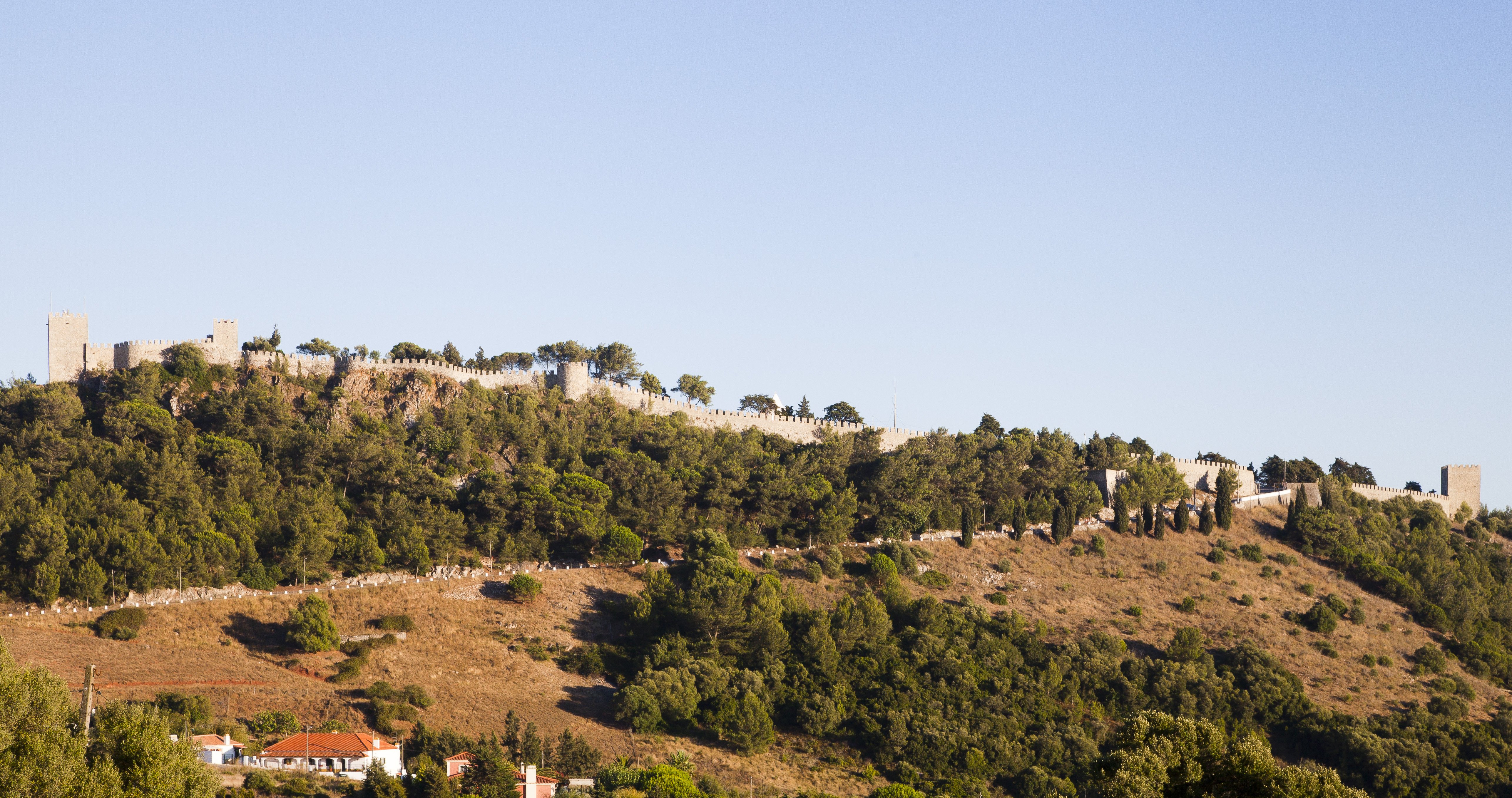
The town sits at the end of a half-moon bay, hemmed in to the east and west by limestone cliffs that drop straight into the sea. Above the centre, the moorish Castle of Sesimbra — a long curtain of stone walls on the ridge — gives the classic view down to the harbour, the beach, and the white-and-blue houses tumbling toward the water. On the seafront, the seventeenth-century Fortress of Saint James anchors the eastern end of the promenade; the little Chapel of Espírito Santo dos Mareantes, tucked into a backstreet, has the faded outlines of medieval votive ships scratched into its walls by sailors hoping for safe return.
The beach itself, Praia do Ouro, runs the length of the town — sheltered, south-facing, and the warmest swimming on the Lisbon coast. From the western end, a coast road climbs out to Cabo Espichel, a wind-scoured headland with a baroque pilgrimage sanctuary and a lighthouse perched on cliffs that drop 130 metres straight to the Atlantic. The dinosaur footprints at the foot of the cliff are visible at low tide.
The eating is what you would hope — grilled fish in the simplest possible preparation, served in tiled tascas along the back streets. The local speciality is choco frito, deep-fried strips of cuttlefish. Two nights covers the town and Cabo Espichel comfortably; combined with Setúbal across the Arrábida, it is a satisfying weekend.
Guide
Beaches
The main town beach, Praia do Ouro, is long, south-facing, and sheltered — the warmest swimming on the Lisbon coast. East of town along the coast road is a string of smaller coves: Califórnia, Lagosteiros, Ribeiro do Cavalo (accessible only by boat or a steep descent), and the dramatic Praia dos Lagosteiros at the foot of Cabo Espichel.
West of town, beyond the harbour, the coast turns wilder and the beaches more remote — Praia do Meco, where naturism is permitted at the southern end, is the best of them, about fifteen minutes by car. All of these are unguarded and exposed to the open Atlantic; the swimming is colder and the swell stronger than at the protected town beach.
Guide
Eating Out
Sesimbra is a fishing town and that is what you eat. The standard catch is grilled simply over wood — sardines in summer, sea bream and dorade year-round, swordfish steaks (espadarte) which the local fleet still lands by the tonne. The town's iconic dish, though, is choco frito: cuttlefish cut into strips, breaded, deep-fried, and served with lemon, rice, and a salad. Every restaurant in town serves it; the smaller tascas along the back streets do it best.
Avoid the international-menu places on the western half of the seafront promenade. The better restaurants are the older family-run rooms in the narrow streets just behind, and the harbourside tascas at the western end near the lota fish market. Look for blackboards rather than laminated menus.
Guide
Getting There
Sesimbra has no train station. The closest railway is in Coina, on the Lisbon-Setúbal line, about 20 km north — bus 207 runs from Coina to Sesimbra in about thirty minutes.
The simplest public transport from Lisbon is the TST 207 or 260 bus from Praça de Espanha or Pragal (the southern end of the 25 de Abril bridge), taking about an hour. By car, the A2 motorway south from Lisbon then the IC32 brings you to Sesimbra in about forty-five minutes — but parking on summer weekends is a real problem and the upper town car parks fill before lunch. Out of season parking on the harbour front or along the eastern beach is easy.
By road from Setúbal, the IC32 over the Arrábida takes about thirty minutes; the smaller N10 along the south side of the mountains is slower but considerably more scenic.