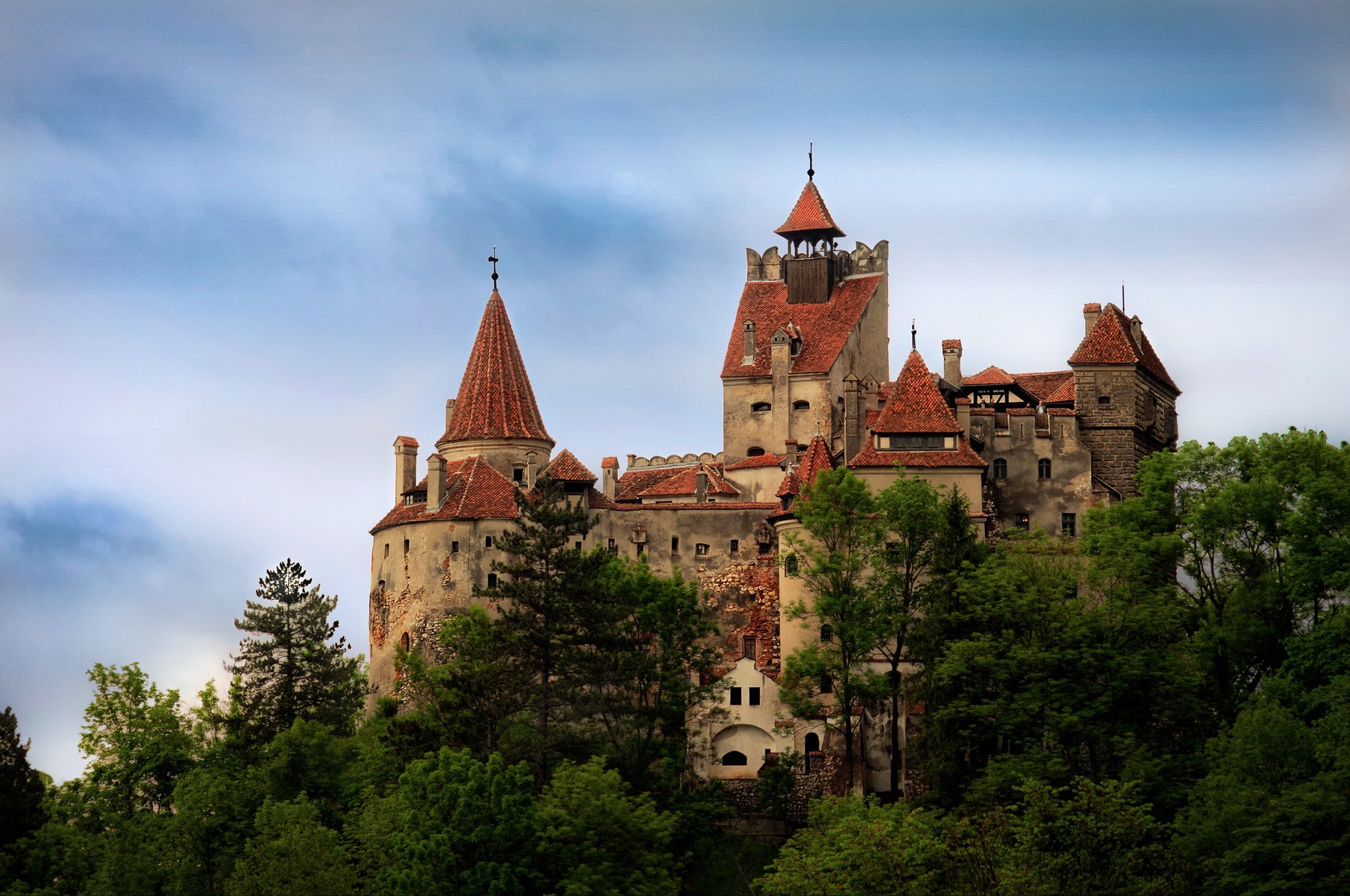
Transylvanian village defined by Bran Castle, a rocky medieval fortress tied to the Dracula legend.
Bran Castle is one of the top attractions in Transylvania and easily reached from Brasov by bus in about half an hour. Although there are no historic sources linking Vlad Tepes — the real-life inspiration for Bram Stoker's Dracula — to this particular castle, popular belief has firmly attached the legend to it. Whatever you make of the Dracula connection, this is a genuinely striking castle perched on a rocky outcrop, and well worth the visit.
Construction began around 1378, combining wood with stone quarried from Magura Branului. The castle served both a defensive and commercial purpose, guarding the mountain pass between Transylvania and Wallachia. Over the centuries it was expanded by Prince Gabriel Bethlen, who added towers and the main gate. The old observatory tower, dated 1622, shows a distinctly Romanian architectural style.
In the 1920s and 1930s, Queen Marie of Romania turned Bran into a royal residence. Fire holes became windows, the well shaft was converted into an elevator room, and medieval stoves gave way to fireplaces. Today the castle operates as a museum displaying Queen Marie's art and furniture collection, alongside exhibits on the castle's medieval history.
The village of Bran itself is small but lively, with a market selling souvenirs, local cheeses, and handmade woolens right outside the castle gates. The surrounding Bucegi Mountains offer good hiking if you want to spend more than an afternoon in the area.
Guide
Books
Dracula by Bram Stoker — the original gothic novel whose Transylvanian setting draws visitors to this region; the castle scenes are vivid even if the real Bran wasn't in Stoker's mind.
Dracula: Prince of Many Faces by Radu Florescu and Raymond McNally — the definitive account of the real Vlad Tepeș and how the Dracula legend grew around him; essential reading for separating myth from history at Bran.
Bradt Romania — the most thorough English-language guide to the country, particularly strong on Transylvania, the Saxon villages, and the Bucegi and Piatra Craiului ranges.
Playing the Moldovans at Tennis by Tony Hawk — a comic account of travelling through Romania on an absurd bet; an affectionate portrait of the country that is still largely accurate about Romanian character and hospitality.
Guide
Day Trips
Brașov (28km north) — the region's main city, with a beautifully preserved medieval walled centre, the gothic Black Church, and a good selection of restaurants and accommodation. The logical base for visiting Bran.
Rășnov Fortress (12km north) — a ruined hilltop peasant fortress with sweeping views over the valley; smaller and less crowded than Bran, and worth combining in a single day.
Piatra Craiului National Park (15km southwest) — a dramatic limestone ridge rising to 2,238m, one of Romania's finest hiking destinations; the main ridge trail is strenuous but the lower paths are accessible to casual walkers.
Peleș Castle (30km east via Sinaia) — the most spectacular of Romania's royal palaces, a neo-Renaissance confection in a mountain setting that makes Bran look modest by comparison.