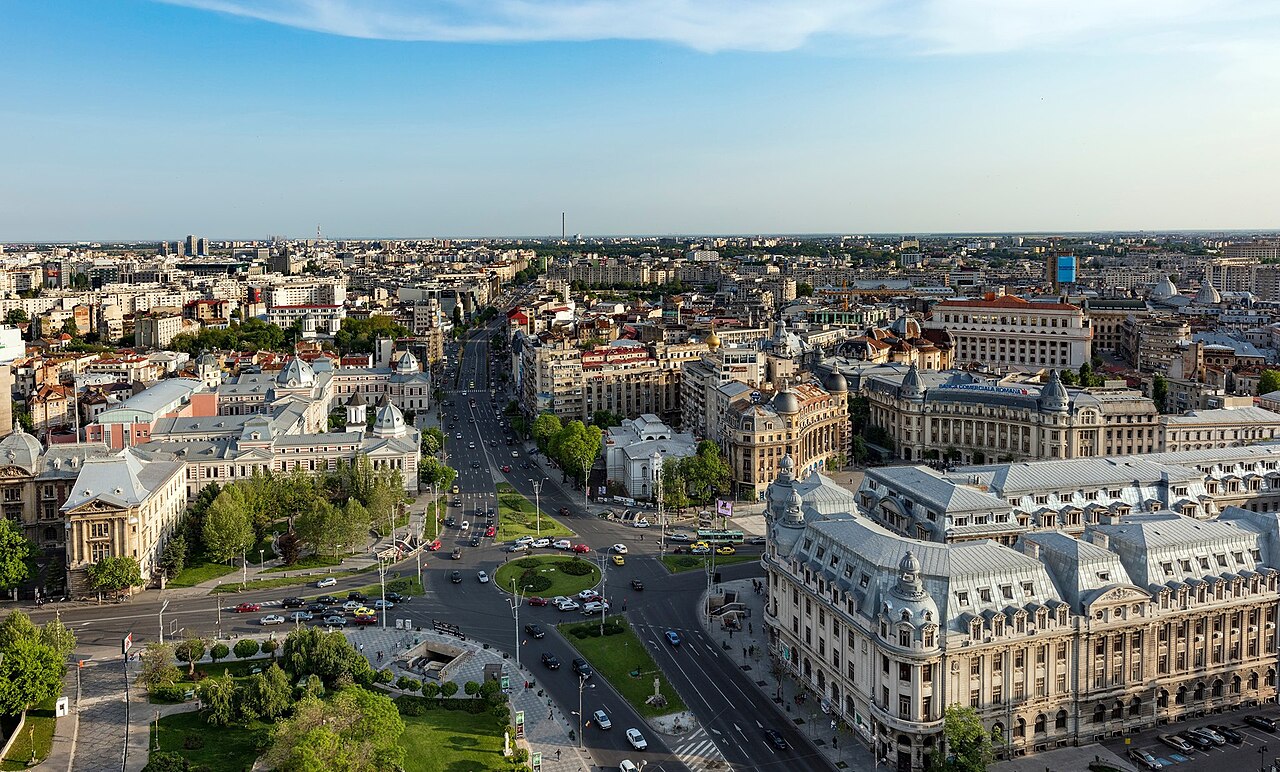
Bucharest was once known as the "Little Paris" for its tree-lined boulevards, Belle Époque architecture, and a café culture that rivalled the French capital in the 1930s. The Communist era tried hard to erase that identity — Ceaușescu demolished a fifth of the historic centre to build his grotesque Parliament Palace — but the old city has proven stubbornly resilient.
Today Bucharest is a messy, energetic capital where crumbling neoclassical mansions sit next to brutalist apartment blocks, and a 16th-century church hides behind a glass office tower. The Old Centre, rebuilt as a pedestrian zone around Lipscani and Covaci streets, is the social heart of the city — packed with bars, restaurants, and the ruins of the Wallachian princes' medieval court. Calea Victoriei, the oldest street in Bucharest, runs north from here past the Romanian Athenaeum, the Royal Palace (now the National Art Museum), and the George Enescu Museum.
The Parliament Palace is unavoidable, in every sense. The second-largest administrative building in the world after the Pentagon, it took 20,000 workers and five years to build, and its marble halls are simultaneously impressive and deeply unsettling. Take the tour — it is the best way to understand what happened to Romania in the twentieth century. For a fuller picture, pair it with the Primaverii Palace, where Ceaușescu actually lived, peacock bathroom and all.
For a gentler experience, spend an afternoon at the Village Museum in Herăstrău Park, one of Europe's finest open-air museums. Dozens of traditional houses, churches, and windmills from every region of Romania are reassembled here on the shore of a lake, and walking through them is the best introduction to the country you will find. Other good escapes from the traffic: Cișmigiu Gardens in the centre, Carol Park to the south, and the unexpectedly wild Văcărești Natural Park, a Ceaușescu-era reservoir that nature has reclaimed.
Eat at Caru' cu Bere for the spectacle and the mici, at Lacrimi și Sfinți or Zexe Zahana for serious modern Romanian cooking, and at the chaotic Obor Market for working-class breakfast. Drink at Origo for coffee, at Control Club for indie music, and at one of dozens of unmarked terraces in Lipscani for the late hours.