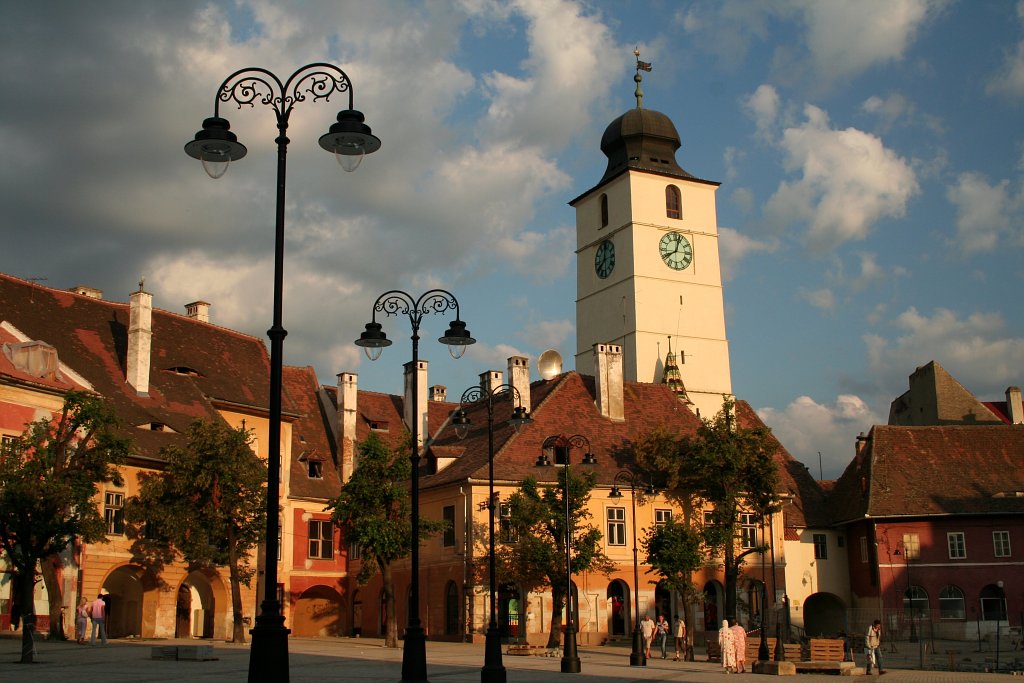
Sibiu (Hermannstadt in German) is one of the best-preserved medieval cities in Central Europe, sitting in the foothills of the Southern Carpathians in Transylvania. It was founded by Saxon colonists in the 12th century, grew into a powerful trading centre, and defended itself successfully against repeated Ottoman attacks in the 15th century with walls, bastions, and towers that still ring the old town.
The old centre has three interlocking squares — Piata Mare (the Grand Square), Piata Mica (the Small Square), and Huet Square — linked by covered passages and surrounded by colourful townhouses, many dating from the 16th and 17th centuries. The characteristic "eye" dormers on the rooftops give the houses a watchful, slightly melancholy look that is unique to Sibiu. The Brukenthal National Museum on the Grand Square holds one of Romania's most important art collections, housed in a fine Baroque palace. The 15th-century Evangelical Cathedral towers over Huet Square; climb the tower for views over the tile rooftops.
The medieval Stairs Passage and the Council Tower connect the two main squares. The ASTRA Open-Air Museum in the Dumbrava forest outside town is one of the finest ethnographic museums in Europe. The Pharmacy Museum in its original 1600 premises is a curiosity worth seeking out.
Sibiu was named a European Capital of Culture in 2007, which helped revive its restaurant and cultural scene — there are now good cafes and restaurants around the old city. The weekly food market and the traditional Christmas market in December are both worth timing a visit around.