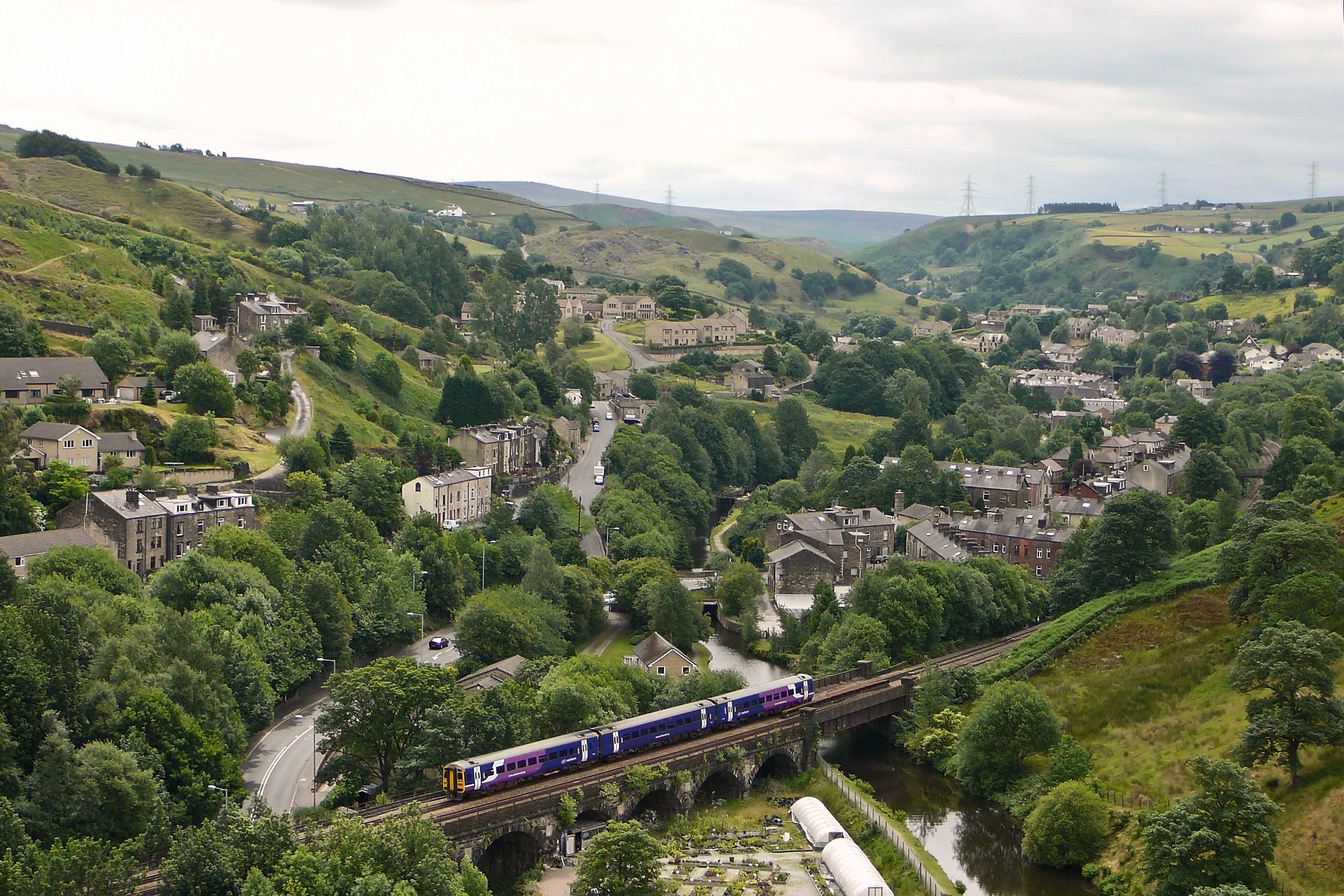
Todmorden sits at the far west of West Yorkshire, at a point where the county boundary with Lancashire once ran beneath the town's grand Italianate town hall — a building that straddles two counties. Now part of Calderdale, the town occupies a steep Pennine valley where the River Calder and several tributaries meet, hemmed in by moorland that rises sharply from the mill-era terraces.
Despite its Yorkshire postal address, Todmorden's industrial character was shaped more by Lancashire cotton than Yorkshire wool. The Fielden family, who owned the principal mill, were the dominant force in town for much of the 19th century — they paid for both the town hall and the Unitarian Church, both designed by the same architect, John Gibson, and both of a quality that would not embarrass a much larger city. Dobroyd Castle, the Fielden family mansion above the town, completes the picture of a community shaped by one family's ambition and nonconformist conscience.
The Rochdale Canal and the trans-Pennine railway were the transport links that made Todmorden viable as an industrial town. Both are worth your attention today: the canal has been restored and the towpath walk east toward Hebden Bridge is excellent, while the railway route through the Calder Valley is one of the most scenic lines in the north of England. Summit Tunnel, just south of town, was the longest railway tunnel in the world when it opened in 1841.
The surrounding moorland draws walkers. Stoodley Pike, the brooding hilltop obelisk a few kilometres east, is the most satisfying short walk from town. Gaddings Dam, a moorland reservoir sometimes called England's highest beach, is excellent for wild swimming in summer. The market, held on Wednesday and Saturday, has genuine character and reflects Todmorden's unusual food culture — the town became internationally known after 2008 as the birthplace of the Incredible Edible movement, which encouraged community vegetable growing in public spaces across the town.