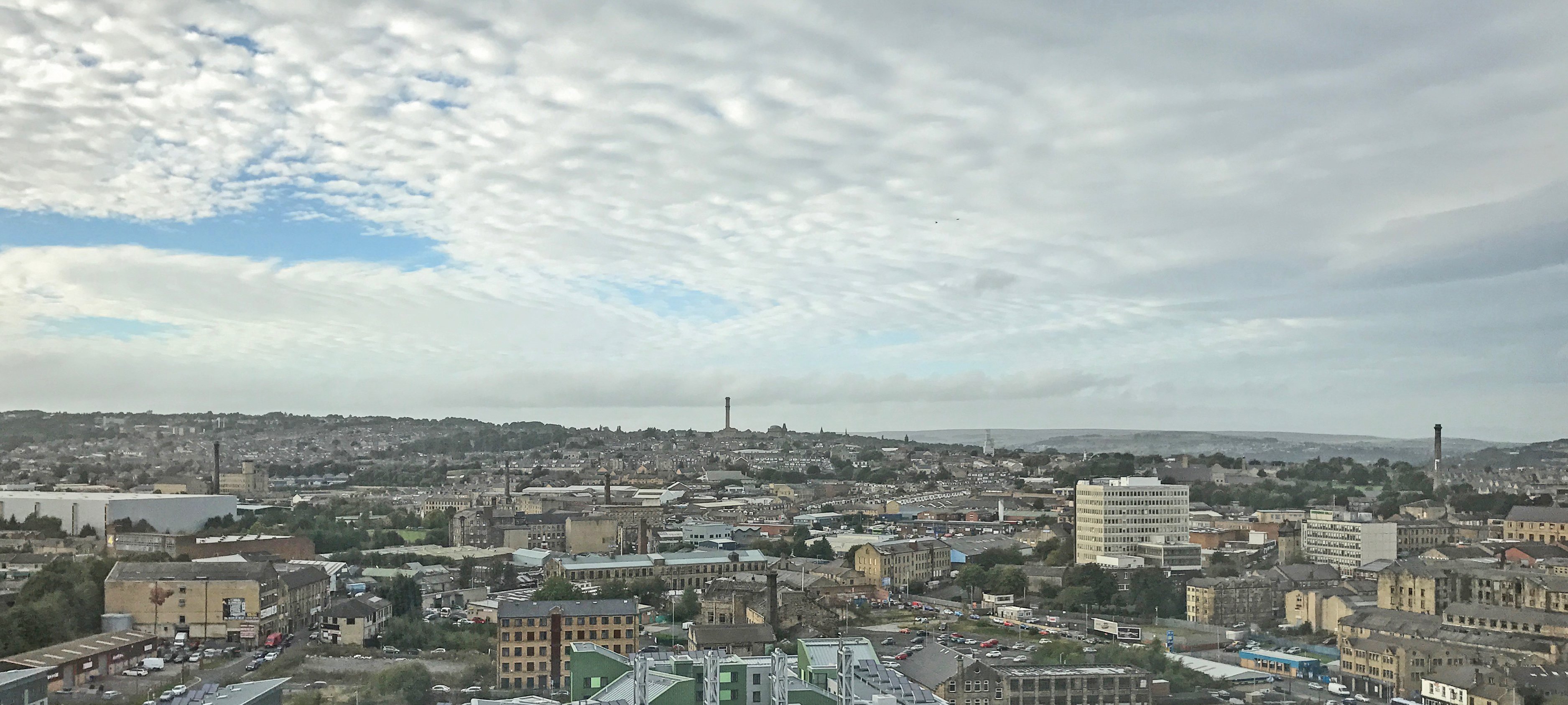
Bradford made its fortune on wool. By the mid-19th century it was the wool capital of the world, a grimy, prosperous mill town that drew workers from across Europe and, later, from South Asia. The industry unravelled after World War II, and Bradford has been reinventing itself ever since — with mixed but often interesting results.
The city punches above its weight culturally. The National Science and Media Museum, right in the city centre, is one of the best of its kind in Britain, and Bradford was named a UNESCO City of Film in 2009, the first in the world. The Victorian Gothic Wool Exchange and Bradford City Hall survive in good condition near the central City Park, and the densely listed Little Germany merchants' quarter is one of the best-preserved 19th-century textile-exporters' districts in Britain. On the southern edge of the Pennines, the surrounding landscape is dramatic: the Yorkshire Moors that inspired Emily Brontë lie just to the north, and the village of Haworth — where the Brontë family lived — is within easy reach.
Bradford's South Asian community, one of the largest in Britain, has transformed the city's food scene. The restaurant strip along Manningham Lane and Mumtaz on Great Horton Road are genuine destinations; the older Karachi Restaurant on Neal Street has been serving the same kitchen since 1965. The city has a complicated history of racial tension alongside genuine multiculturalism — both are part of its story.
The suburb of Saltaire, a few kilometres north, is a World Heritage Site: a complete Victorian model village built by the wool magnate Sir Titus Salt in the 1850s. Salt's Mill at its centre now houses an extraordinary collection of David Hockney paintings, a fine café, and design shops. It is one of the most rewarding half-days in the north of England.