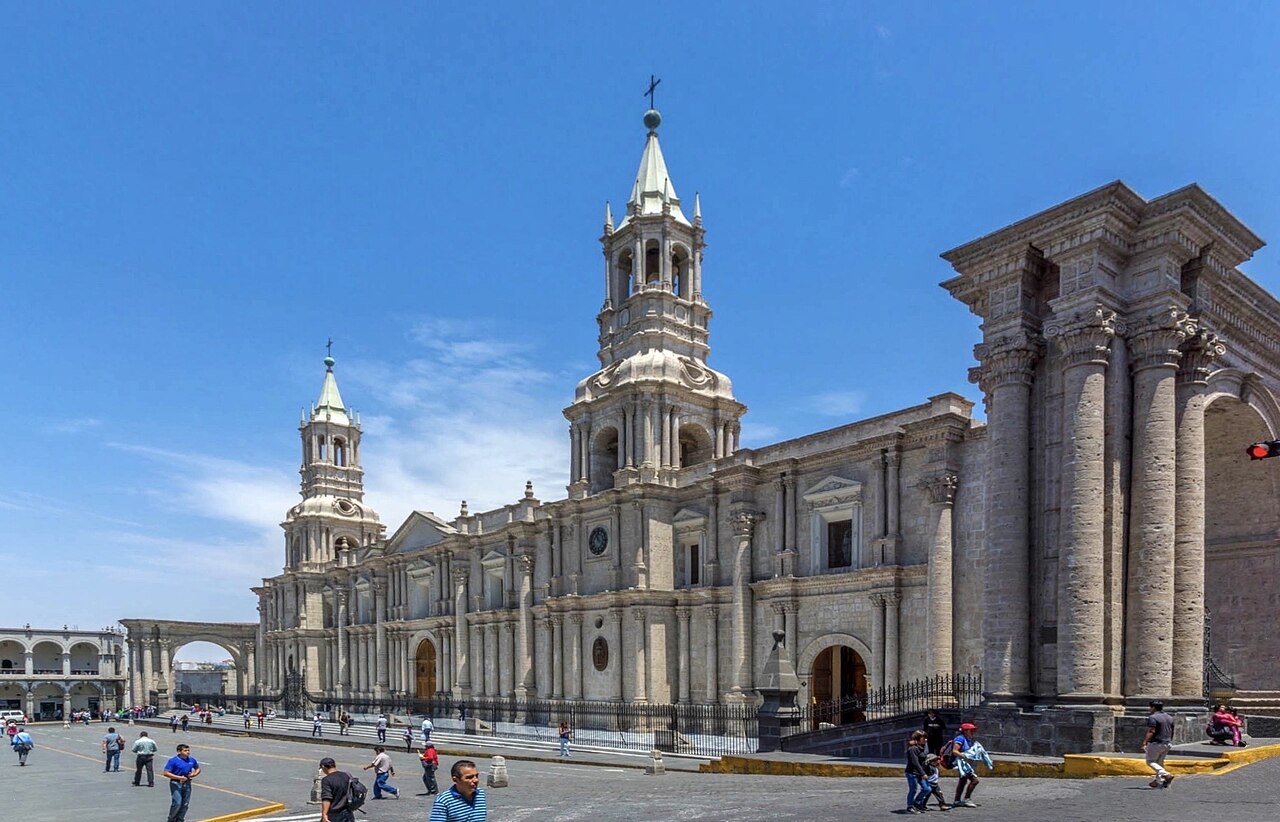
Arequipa is Peru's second city, built from white volcanic stone (sillar) quarried from the slopes of El Misti, the 5,822-metre volcano that rises picture-perfectly behind the city. They call it La Ciudad Blanca — the White City — and in the midday sun the colonial centre gleams so brightly it is almost hard to look at. It is one of the finest Spanish colonial cities in South America, a UNESCO World Heritage Site since 2000, and a city that most travellers find more immediately likeable than Lima: compact, walkable, sunny (300+ days a year), and set in a dramatic valley flanked by three volcanoes.
The centrepiece is the Plaza de Armas, as handsome as any in Peru, with the massive white cathedral stretching along one entire side and views of El Misti framed at the end of every street. But the real highlight is the Monasterio de Santa Catalina, a five-acre convent founded in 1579 and closed to the public for nearly four hundred years. It was opened in 1970 and is now the most extraordinary thing in Arequipa: a self-contained city-within-a-city of painted cloisters, narrow streets, tiny plazas, and the cells where nuns lived in almost total isolation for centuries. Allow two hours. The Museo Santuarios Andinos, near the plaza, holds "Juanita," the frozen Inca maiden discovered on the summit of Ampato volcano in 1995 — one of the best-preserved Inca mummies in the world.
Arequipa is also the main base for the Colca Canyon, about four hours north-west by road and one of the deepest canyons in the world at 3,400 metres from rim to river. Most visitors come for the Cruz del Cóndor viewpoint, where Andean condors — the largest flying birds in the world — ride the thermals up from the canyon floor in the early morning and sweep past at eye level. The canyon also offers multi-day trekking, hot springs at Chivay, and pre-Inca agricultural terraces still in active use. The two-day guided tour from Arequipa is the standard format.
Eat rocoto relleno (stuffed hot peppers), chupe de camarones (shrimp chowder), and the local chicha de jora (fermented corn beer). The restaurant scene along Calle Jerusalén is the best in the city — better than the tourist-trap places facing the plaza. Take the bus rather than the flight if you're coming from Puno or Cusco: the altitude adjustment is gentler by road, and the landscape on the way is extraordinary.