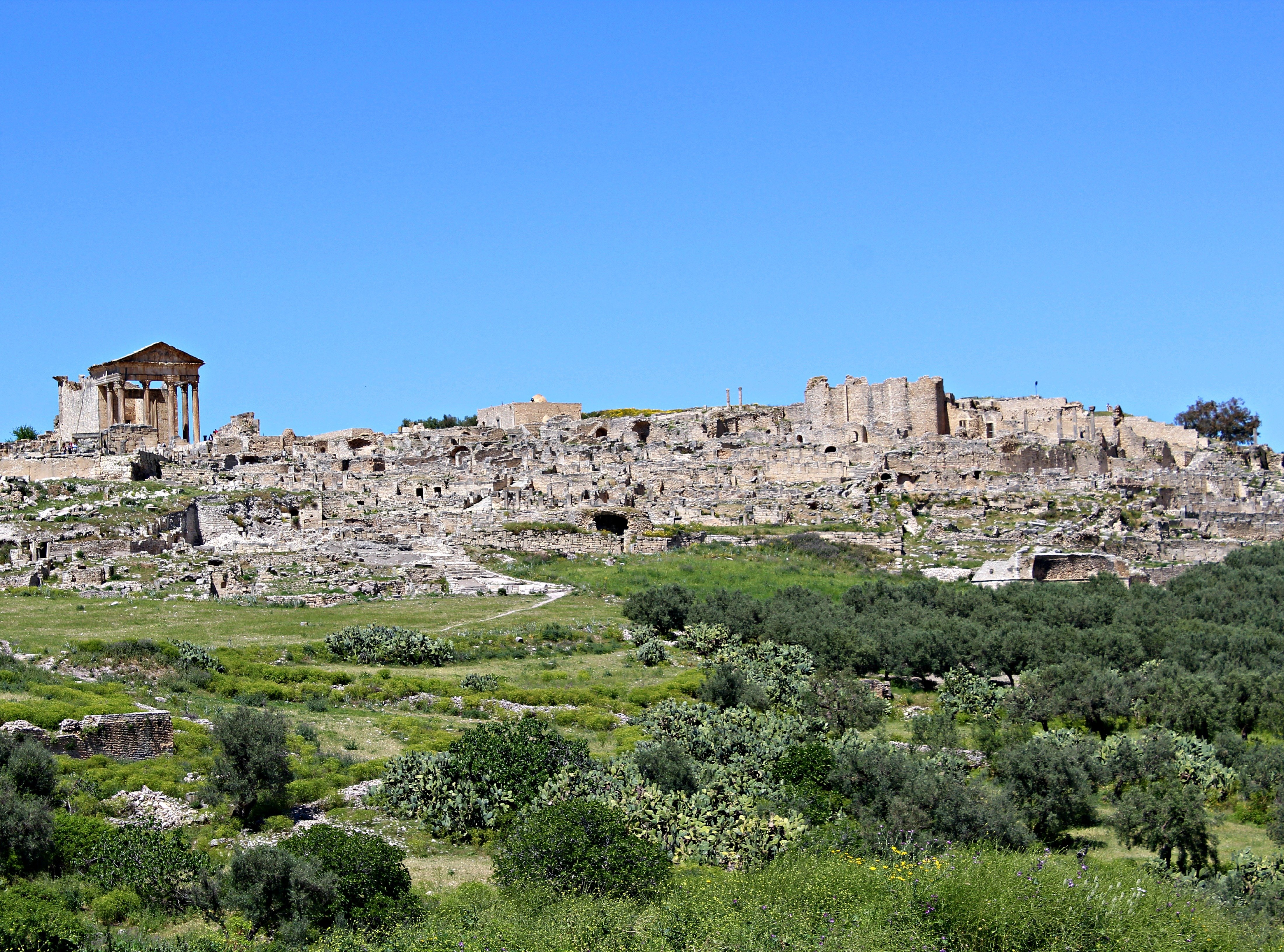
Dougga sits on a hillside in northern Tunisia, roughly 110 km southwest of Tunis, and it rewards the journey handsomely. This is arguably the finest Roman site in North Africa — not because it is the largest, but because it is so complete. Wandering its streets, you pass intact temples, latrines, baths, and private houses in a state that most Mediterranean ruins can only hint at. The hilltop setting adds to the drama: the ruins spill down a slope above a valley of olive trees, and on a clear morning the light over the Medjerda hills is extraordinary.
The Capitol, dedicated to the Capitoline triad of Jupiter, Juno, and Minerva, dominates the site. Built in the 2nd century AD, its columns and pediment still stand to their full height — an image that appears on Tunisian banknotes. The theatre is among the best-preserved in the Roman world, seating around 3,500 spectators, with its tiered stone seats, stage wall, and orchestra largely intact. Standing on the upper tiers, looking out over the valley, is one of those genuinely transporting travel moments.
Dougga was not a Roman creation from scratch. Long before Rome arrived, a Numidian city called Thugga occupied this hill, and the Libyco-Punic Mausoleum on the edge of the site is its most visible survivor. Dating to the 2nd century BC, this three-storey funerary tower predates Roman influence and stands as a reminder that North Africa had sophisticated urban cultures before the legions. The Punic and Berber substrate shows up throughout the site in inscriptions, in the layout of older streets, and in the spatial logic of the city beneath the Roman overlay. Dougga is a UNESCO World Heritage Site.
Getting to Dougga from Tunis takes about two hours. Louages (shared taxis) run from Tunis to Téboursouk, the nearest town, from where a short taxi ride reaches the site. The site has basic facilities but no shade beyond the monuments themselves, so bring water and a hat. Entry is inexpensive and crowds are usually manageable — this is one of those places that feels quietly underrated even while appearing in every guidebook.