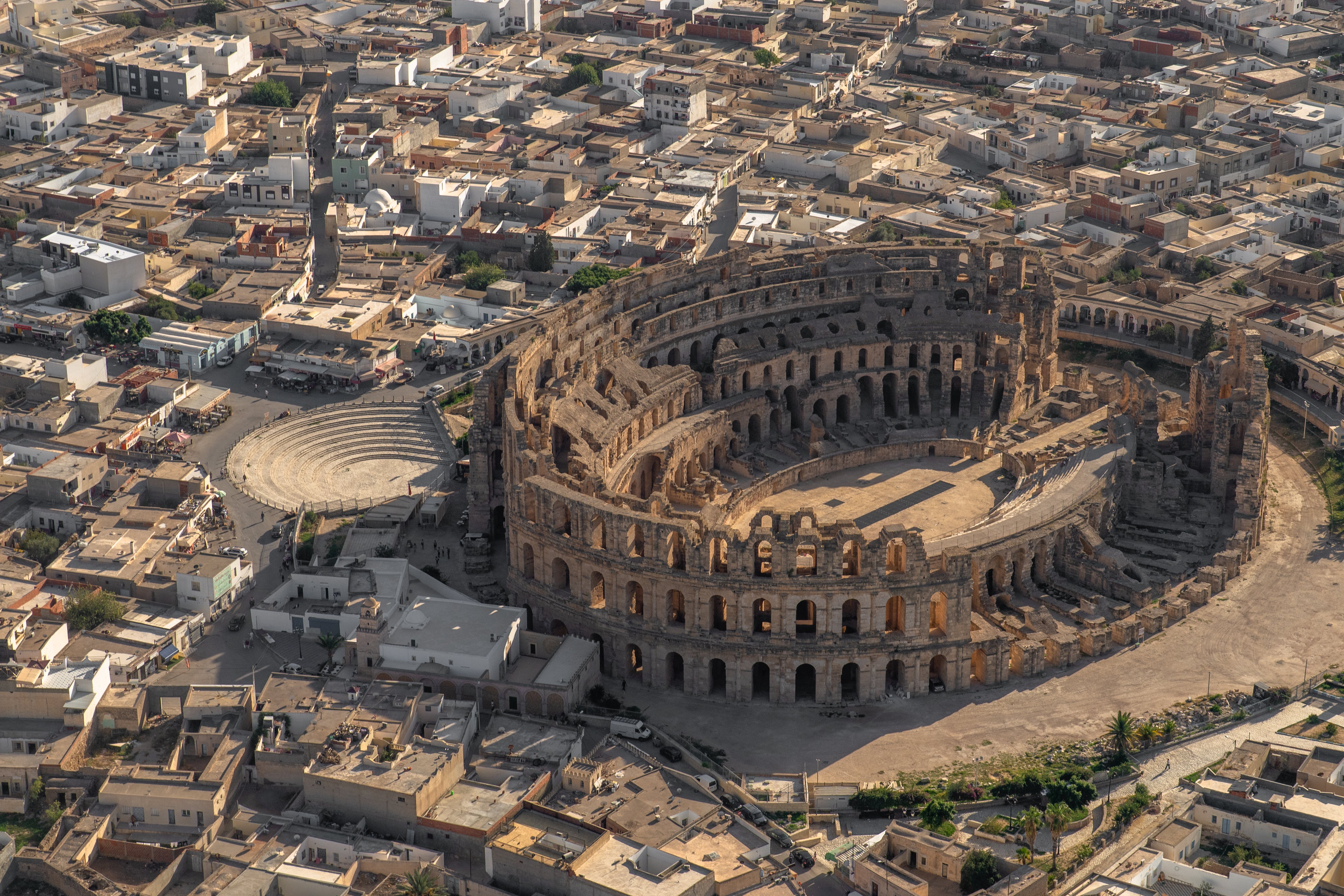
El Jem is a small Tunisian town with one very big reason to visit: the Amphitheatre of Thysdrus, one of the best-preserved Roman amphitheatres in the world. It stands just a few minutes' walk from the centre of town, rising abruptly above the low modern buildings around it — an enormous stone oval that seats 35,000, built in the 3rd century AD when this region was one of Rome's most productive olive-growing provinces.
The amphitheatre is often compared to the Colosseum in Rome, and the comparison is fair. It is the third largest Roman amphitheatre ever built, and in some ways better preserved than its Roman counterpart — much of the facade is intact, and the underground passages where gladiators and animals waited before combat are open to walk through. Standing in the arena floor, looking up at the tiers of arches, the scale is genuinely impressive.
The town also has an archaeological museum with a fine collection of Roman mosaics recovered from villa sites in the surrounding countryside. The mosaics are vivid and well-displayed — scenes of hunting, mythology, and daily life that give a sense of how wealthy this olive-rich region once was.
Beyond the amphitheatre and museum, El Jem is a quiet provincial town. Most visitors come as a day trip from Sousse or Tunis, but lingering for a few hours is worthwhile — the amphitheatre is particularly atmospheric in the late afternoon when the tour groups have left.