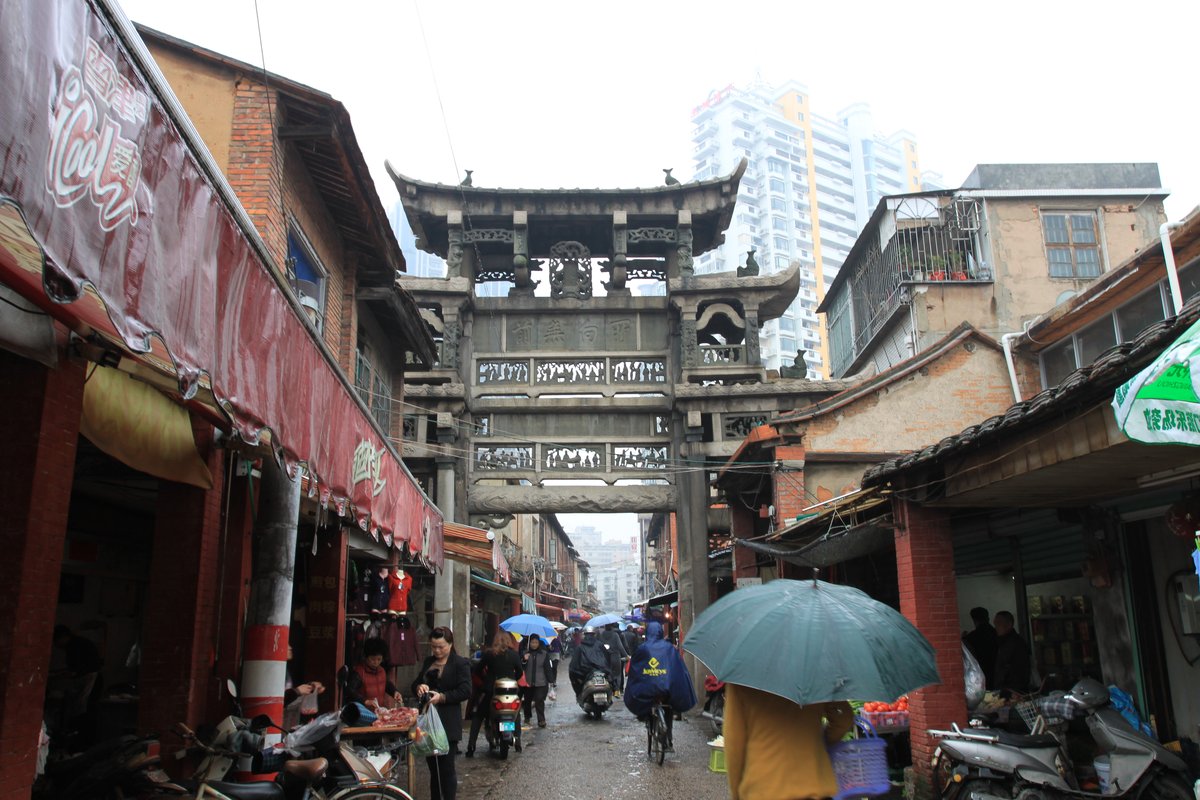
Zhangzhou is a prefectural city of nearly five million in southwestern Fujian, tucked between the mountains and the sea about an hour's bus ride from Xiamen. It is the kind of place where Chinese tourists come but foreign visitors rarely do, which gives it an unhurried quality that the more-polished cities of the province lack. The old city along the Jiulong River has enough historic temples and tile-roofed lanes to occupy a full day, and the surrounding countryside is some of the most varied in Fujian.
The Nanshan Temple, founded in 736 CE, is one of the oldest functioning Buddhist complexes in southeastern China and well worth an unhurried morning. Out in the rural counties, Nanjing has its own cluster of Fujian Tulou distinct from the more-visited Yongding group, and in Zhangpu County the 17th-century stone fortresses of Yi'anbao and Zhaojiabao are striking examples of Ming defensive architecture that most visitors to the province never reach. The Dongshan Peninsula, a windswept headland in Dongshan County, combines ancient fortress ruins with accessible beaches and some of the most photogenic coastal rock formations in Fujian.
Zhangzhou also has a serious food identity. It is the original home of lor mee — braised noodles in a thick, starchy sauce — the dish that travelled with Hokkien emigrants to Singapore, Malaysia, and Indonesia and became a staple of Southeast Asian hawker culture. Local oyster omelettes are made with a crispier, lighter batter than in Xiamen, and the region produces white and black teas alongside the oolongs that dominate the rest of the province. The most practical base is Zhangzhou city itself, served by high-speed rail on the Xiamen–Shenzhen line.