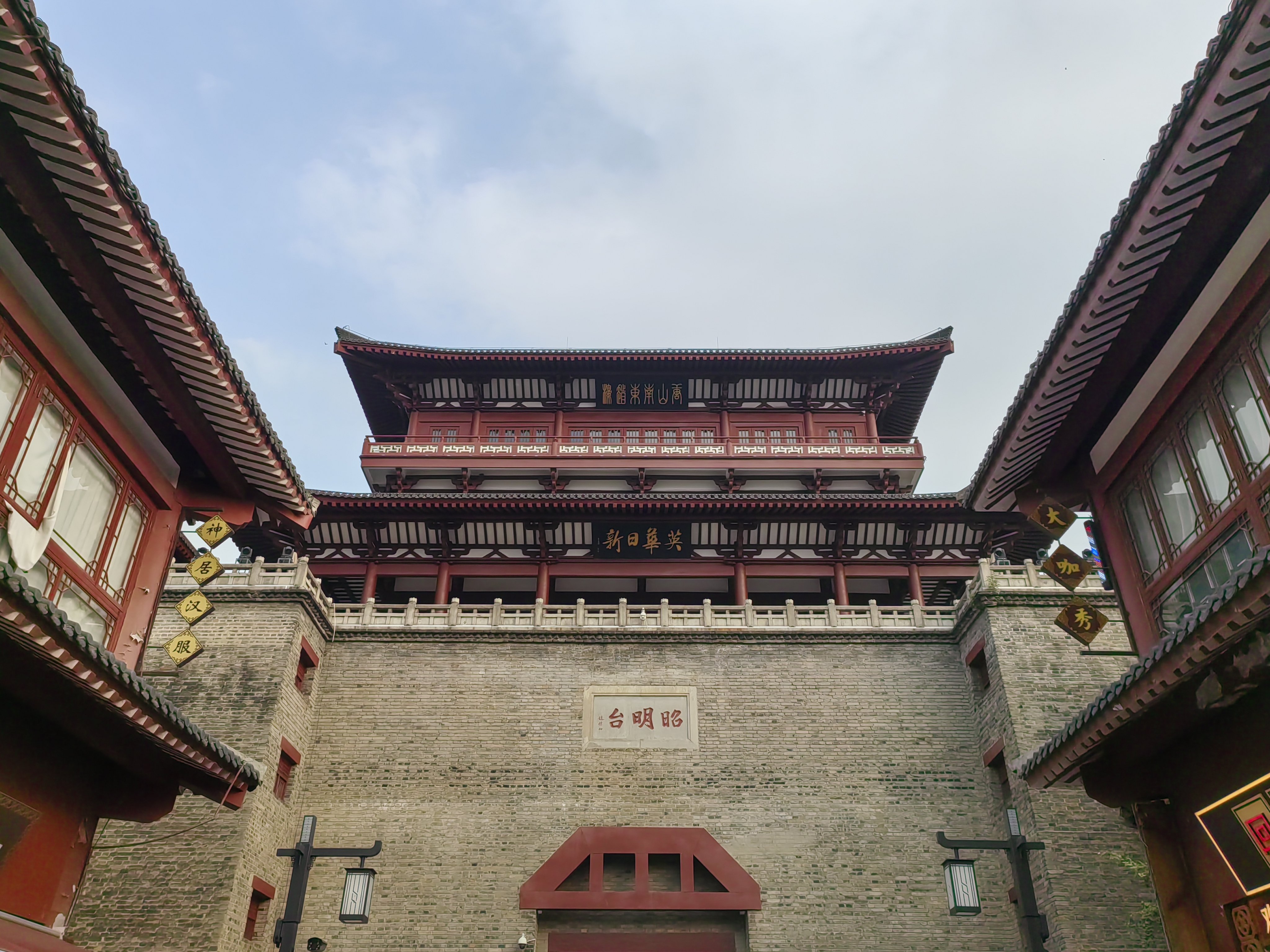
Xiangyang sits where the Han River squeezes through a gap between hills in northern Hubei, and for most of Chinese history that geography made it the most strategically important city in central China. Whoever held Xiangyang controlled the corridor between north and south. In the thirteenth century, Kublai Khan's Mongol army spent five years besieging the city before it finally fell — the decisive breach that allowed the Yuan dynasty to complete its conquest of China. The city walls that stand today are largely Han dynasty in origin, 7.3 kilometres of them, surrounded on three sides by water, and they are free to enter and walk.
The other great attraction is Gulongzhong, the rural retreat where the strategist Zhuge Liang lived in deliberate obscurity before Liu Bei came to recruit him. The story of Liu Bei's three visits to the thatched cottage — each time turned away, returning without complaint — is one of the foundational tales of Chinese statecraft, a parable about the patience required to win truly exceptional talent. The site itself is pleasantly low-key for a 5A-rated scenic area: wooded hills, a reconstructed cottage, the Hall of Three Visits, and a Wuhou Shrine. It is about fifteen kilometres outside the city centre.
Xiangyang was renamed from the clunky compound name Xiangfan in 2010, restoring the ancient city's identity. The modern city straddles the Han River, with the historic Xiangyang district on the south bank and Fancheng — historically a separate city — on the north. The two banks have a different character: Xiangyang side has the old walls and the tourist infrastructure, Fancheng is more workaday and has better street food. The local specialty is beef noodle soup in a clear, intensely flavoured broth, eaten early in the morning at pavement stalls that fold up by nine.
The Xiangyang Museum holds more than four thousand artefacts from prehistoric times through the Qing dynasty — bronzes, jade pieces, ceramics — and admission is free. The city is on the high-speed rail network and makes a reasonable day trip from Wuhan, though the walls and Gulongzhong together justify an overnight stay.