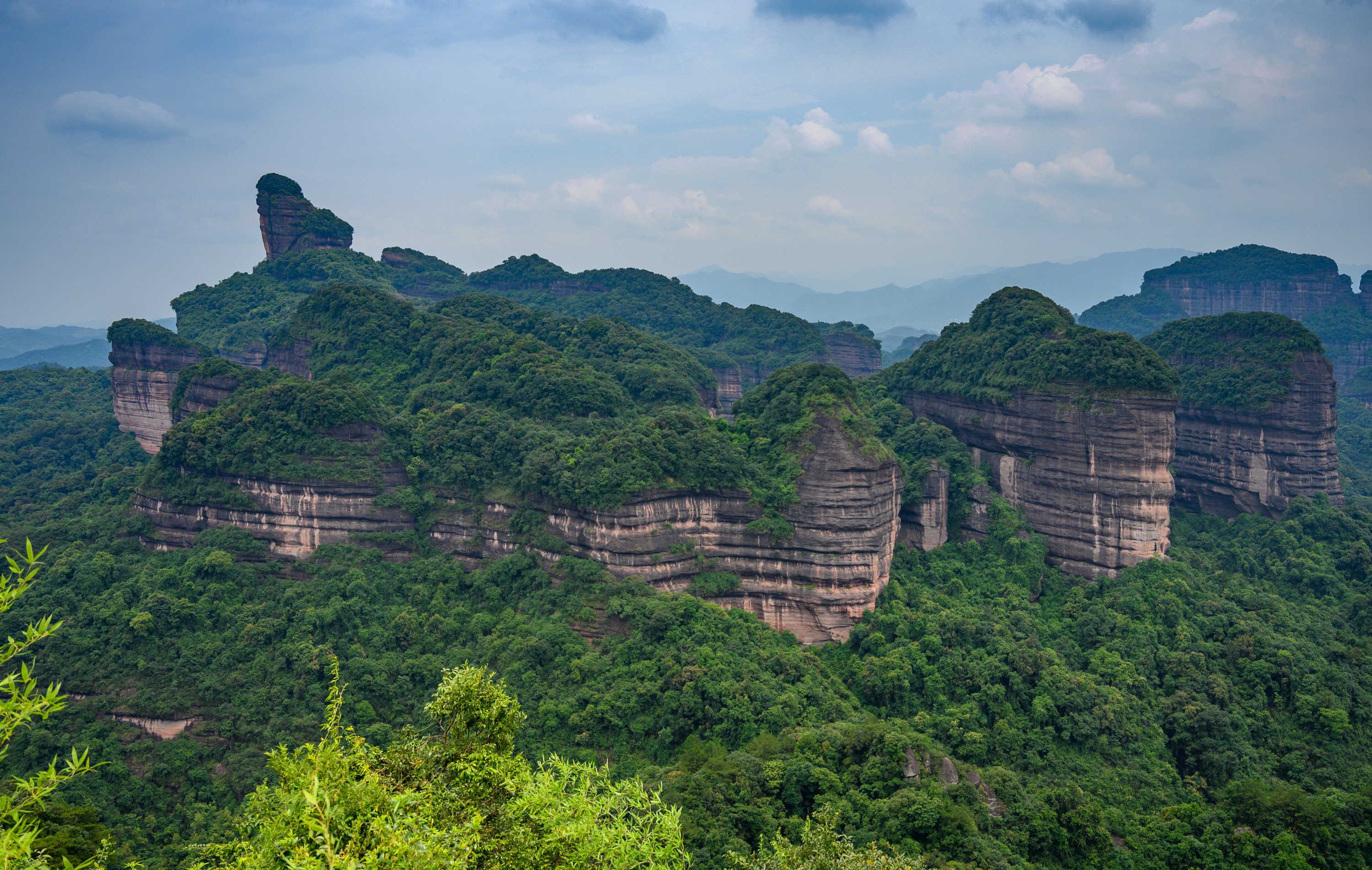
Shaoguan sits at the northern edge of Guangdong, where the province bumps up against the Nanling mountains and the air is noticeably cooler than the Pearl River Delta. The city itself is unremarkable, but it serves as the base for two of the most interesting natural sites in southern China. The first is Danxiashan, a UNESCO World Natural Heritage site about an hour away by bus, where millions of years of red sandstone deposition and erosion have produced a landscape of towers, cliffs, and canyon slots the colour of dried blood — the defining example of what geologists call danxia landform. The second is the Nanling National Forest Park, which contains the only remaining primary forest in Guangdong and the province's highest peak, Shikengkong, at 1,902 metres.
Nanhua Temple, about 25 kilometres south of the city, is a major pilgrimage destination for Chinese Buddhists: it was the home monastery of Huineng, the sixth and most influential patriarch of Chan (Zen) Buddhism, who died here in 713. His mummified body is still on display in the main hall, sitting in a glass case with a gold-painted exterior. The temple has been rebuilt many times, but the setting — in a narrow river valley surrounded by forested hills — retains something of its original remoteness.
Shaoguan is also notable for its ethnic diversity by Guangdong standards. Yao minority communities live in the surrounding mountains, maintaining their own language and culture, and the city's primary local dialect is Hakka rather than Cantonese. This linguistic complexity is part of what makes the region feel culturally distinct from the coastal cities, and the hot springs scattered through the hills have long made it a weekend retreat for residents of Guangzhou.
The bullet train from Guangzhou takes about an hour, making Shaoguan genuinely feasible as a day trip for Danxiashan alone — though the park is large enough, and interesting enough, to justify staying longer. The geology is serious: the park's rock formations are over sixty million years old, and the light on the red cliffs at dusk has the slightly theatrical quality of a landscape that knows it's beautiful.