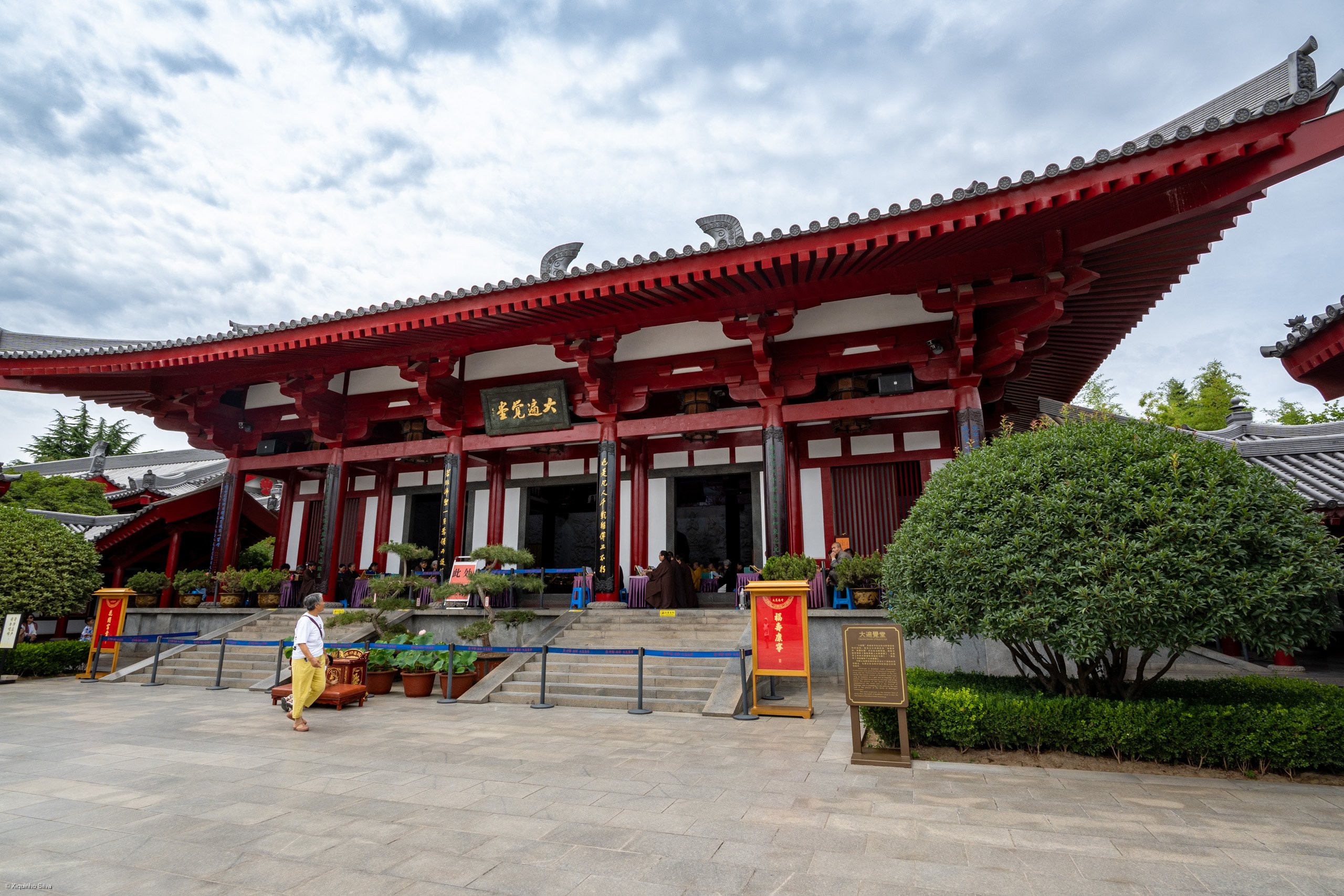
Daci'en is the temple complex around the Big Wild Goose Pagoda, and the historical reason the pagoda was built. The Tang emperor Gaozong founded it in 648 in memory of his mother, and a few years later he installed the monk Xuanzang here as abbot, with a brief to translate the sutras Xuanzang had brought back from a 17-year journey to India. The pagoda was built to house those scrolls; the temple courtyards around it housed the translation school. Most of the wooden architecture is later — Ming and Qing — but the layout, and the sense of a working translation centre that ran for a century, is still legible.
At the main gate, two octagonal stone pavilions dating to the Tang period flank the courtyard entrance, each sheltering an inscribed stele — one commemorating the founding of the temple by the Tang emperor Taizong, the other a portrait of Xuanzang. Inside the gate, the courtyard sequence leads north through the Hall of the Heavenly Kings, the main worship hall, and finally to the base of the pagoda itself. The bronze statue of Xuanzang in the south plaza, installed in the 1980s, shows him carrying a tall bamboo frame laden with scrolls — the standard depiction of his return journey.
Most visitors do the temple and pagoda on a single ticket. The temple courtyards are the calmer half of the experience and worth lingering in. The square north of the main gate has the largest musical fountain in Asia, with nightly performances. The entire complex is about four kilometres south of the Xi'an city walls.