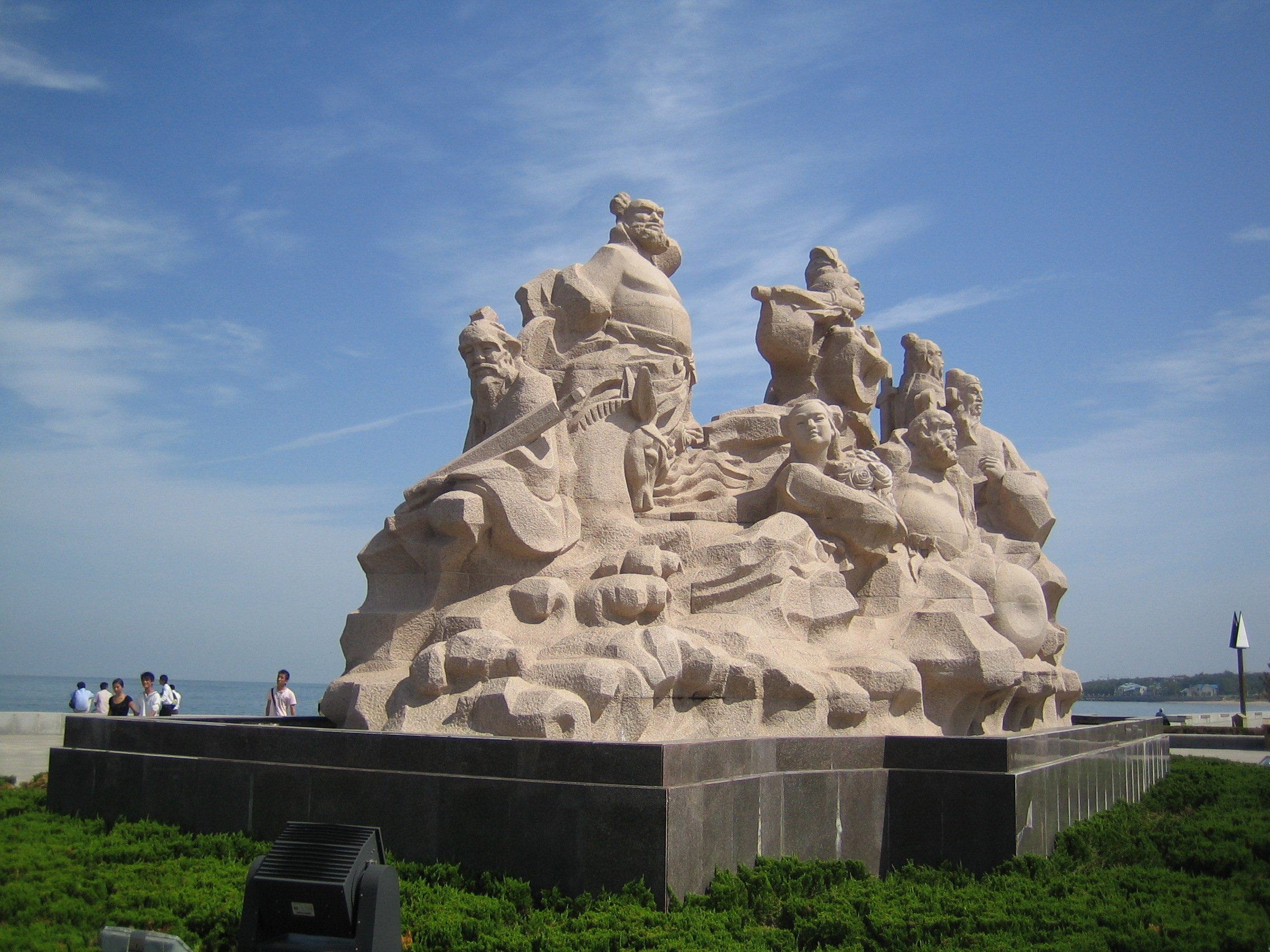
Penglai sits on cliffs above the Bohai Strait and has been associated with Taoist mythology for two thousand years. The Eight Immortals of Chinese legend are said to have crossed to the sea from here, and the city's habit of producing mirages over the water — cold-water currents meeting warm air create convincing false images of distant lands — made it easy for early visitors to believe that fairy islands lay just offshore. The Penglai Pavilion, perched on the headland above the sea, was built during the Song Dynasty and is ranked among the Four Great Towers of China; it is genuinely dramatic in its setting, with walls, temples, and a lighthouse all crowded onto the clifftop above the strait.
The pavilion complex extends across several terraced levels, mixing Taoist and Buddhist temples with a lighthouse that guided shipping along one of the ancient world's busiest sea lanes. Penglai was a major node on the Maritime Silk Road and a key naval base, and the Dengzhou Ancient Ship Museum nearby houses actual Yuan and Ming Dynasty vessels excavated from the harbor — unusual in that you are looking at real ships rather than reconstructions. The Changdao Islands, a chain of small islands visible from the cliffs, can be reached by ferry in about 30 minutes; they are quieter and less developed than the mainland, and are a superb autumn raptor migration watchpoint.
Penglai is now administratively part of Yantai, and the international airport that serves both cities carries Penglai's name. From Yantai the drive is about an hour, and most visitors combine the two in a single trip. The seafront has excellent fresh seafood restaurants, and the Changyu winery — China's oldest, dating to 1892 — is worth a visit for its wine tasting and improbable château architecture.