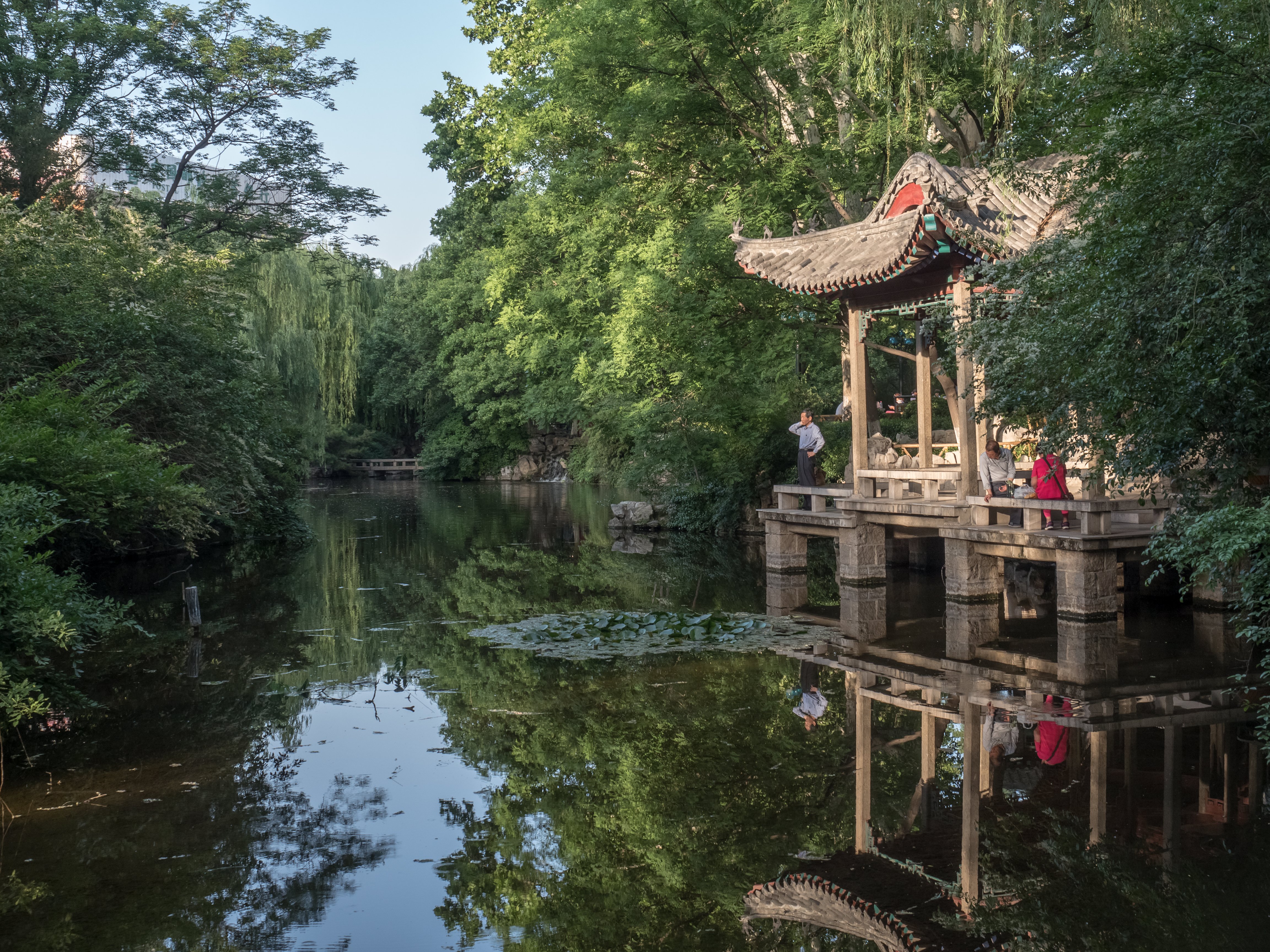
Jinan earns its nickname "City of Springs" honestly: dozens of artesian wells bubble up through the limestone beneath the city, and for centuries people have organized their lives around them. The water collects in Daming Lake, a broad reed-fringed lake in the north of the city center that has been a focal point for poets and painters since the Tang Dynasty. Baotu Spring, the most famous of the wells, has flowed continuously — according to the records — for 2,700 years, and the park around it is one of the few genuinely pleasant urban parks in northern China, full of willows and stone bridges.
The city divides loosely into three tiers: Daming Lake and its temples in the north, Quancheng Square and the commercial center in the middle, and Qianfo Mountain to the south, where hundreds of Buddha figures are carved directly into the cliff face. The German colonial district near the old train station is modest compared to Qingdao's, but a few blocks of red-brick buildings survive to remind you that European powers carved up Shandong's hinterland just as thoroughly as its coast. The provincial museum has a strong collection of Longshan "black eggshell pottery," some of the thinnest ceramics ever made — walls under a millimeter — dating from 3000 BCE.
As the provincial capital and the main rail hub for Shandong, Jinan is a natural base for the region. High-speed trains reach Beijing in two and a half hours and Shanghai in three and a half; Tai'an is twenty minutes away, making a day trip to Mount Tai straightforward. The city is dense, busy, and not especially beautiful, but the springs give it a character that distinguishes it from most large Chinese provincial capitals, and the old street grid around Furong Street has good cheap food.