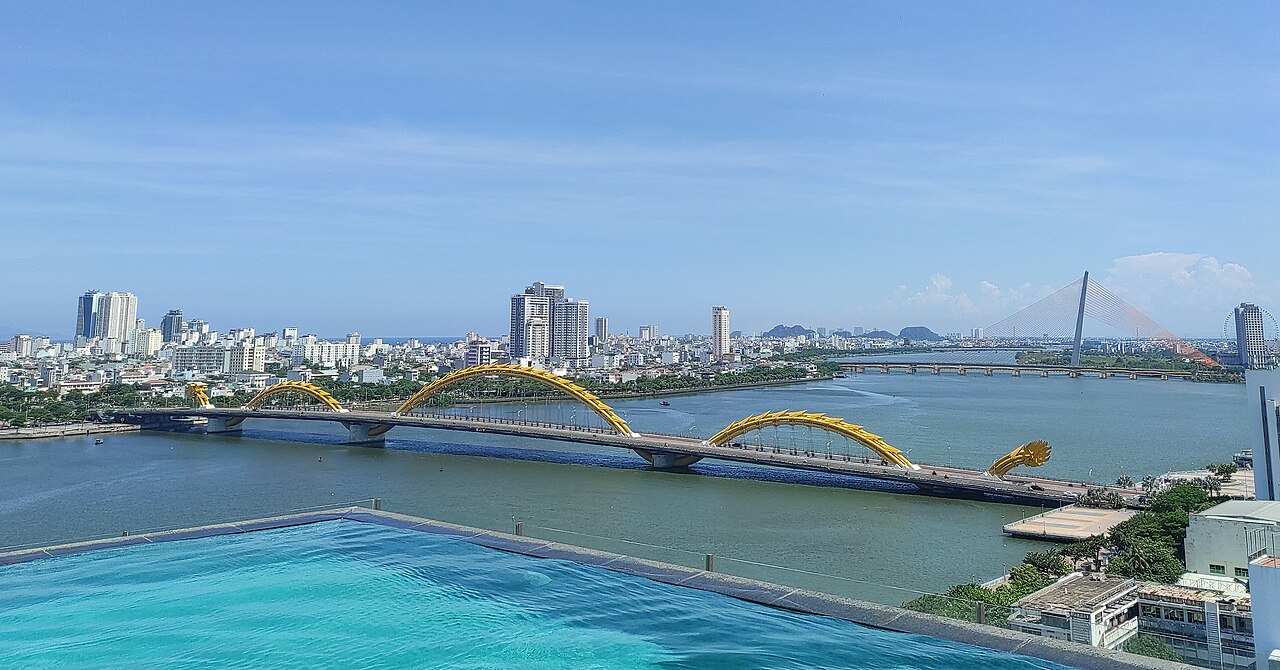
Da Nang is the largest city on Vietnam's central coast and, increasingly, one of the most interesting places in the country. It sits roughly halfway between Hanoi and Ho Chi Minh City, on a broad crescent of bay where the Han River meets the South China Sea, backed by the forested bulk of the Marble Mountains. For most of the 20th century it was known to Western travellers only as the large American airbase during the Vietnam War — the first US Marines waded ashore at China Beach just south of the city in March 1965, and Da Nang's airport handled more flights than any other in the world during the war years. In the 21st century the city has reinvented itself as one of Vietnam's most prosperous and best-planned urban centres, with a string of new luxury resorts along the beach and a reputation as the easiest big Vietnamese city to live in.
The signature sights are mostly geological. The Marble Mountains (Ngũ Hành Sơn) — five limestone and marble hills rising abruptly out of the flat coastal plain — contain dozens of Buddhist caves, grottoes and pagodas that have been sacred pilgrimage sites for centuries; the tunnels honeycombing the largest peak were also used by Viet Cong fighters during the war. The Ba Na Hills station, an hour inland, is a French-built hilltop resort at 1,487 metres with a cooler climate, a cable car (one of the longest single-span cable cars in the world), and the instantly-Instagrammable Golden Bridge held up by two enormous stone hands. The excellent Museum of Cham Sculpture in the city centre holds the finest collection of Cham Hindu art in the world — a reminder that this coast was once the heart of the long-vanished Cham kingdom, whose great temple city of My Son lies 40 km to the south-west.
The My Khe Beach (the old American "China Beach") and the stretch of coast south to Hoi An are lined with resort hotels. Hoi An itself — a UNESCO-listed old trading port with wooden merchant houses, Japanese covered bridges, and some of the best food in Vietnam — is a 45-minute drive south and should be on everybody's itinerary; most travellers base themselves in Hoi An and day-trip into Da Nang rather than the other way round. The old imperial capital of Hue, 100 km north over the spectacular Hai Van Pass, is the other obvious day trip.