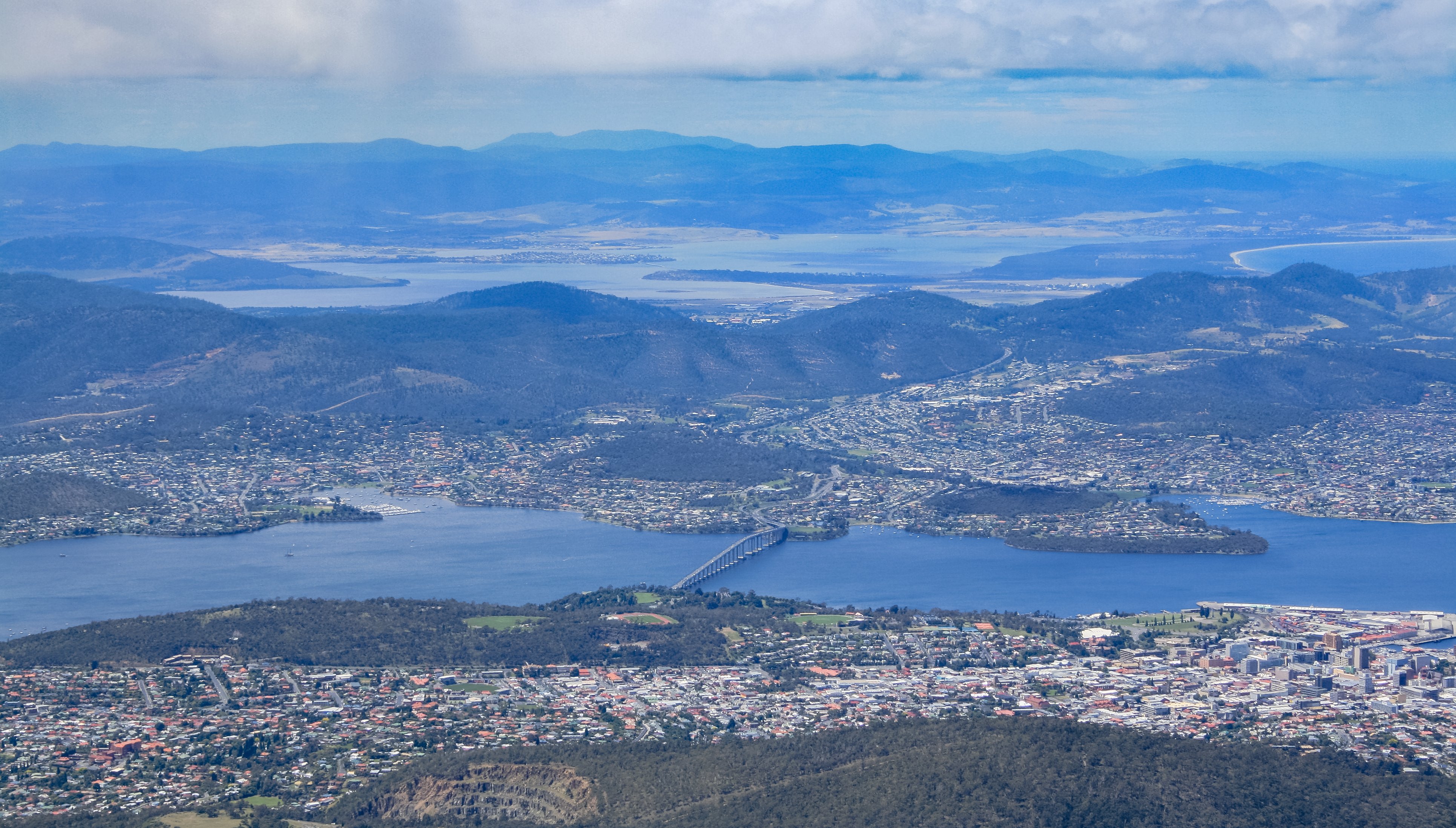
Hobart is the capital of Tasmania and the second-oldest city in Australia after Sydney, founded in 1804 as a British penal settlement on the Derwent River. It is also the smallest Australian capital, with around 250,000 people spread along the deep estuary where the river meets the Tasman Sea, and it has a character all its own — colder, quieter, and more rooted in landscape than any other Australian city. Mount Wellington (Kunanyi in the local Mouheneenner language) rises 1,271 metres directly behind the town, snowy in winter, and you can drive to the summit for one of the most dramatic city-and-sea views in the world.
The old heart of the city is around Sullivans Cove and Salamanca Place, where a row of 19th-century sandstone warehouses has been converted into galleries, cafés, shops, and bars. The Salamanca Market, held every Saturday since 1972, is the social high point of Hobart's week: stalls selling Tasmanian produce, crafts, woodwork from local rainforest timber, and street food, with a band playing on the grass behind. Just behind Salamanca, Battery Point is the old seafarers' neighbourhood — narrow lanes of convict-built cottages, the little Arthur Circus village green, and the 1836 St George's Church overlooking the river.
The city's single most remarkable attraction is MONA (the Museum of Old and New Art), twenty minutes north of the centre and reached by a small custom-built catamaran from Brooke Street Pier. David Walsh's subterranean museum, built into the sandstone cliffs of a peninsula on the Derwent, is one of the most important and eccentric private art collections in the world — ancient Egyptian sarcophagi sit beside confrontational contemporary installations, and the visitor experience is run through an app rather than wall labels. Plan for half a day. In June, MONA hosts Dark Mofo, the winter solstice festival of art, music, and ritual that has become Australia's most unusual cultural event.
Hobart is a natural base for exploring the wider island. Port Arthur, the 19th-century convict penal colony and one of Australia's most affecting historical sites, is 90 minutes south-east. Mount Field National Park is an hour north-west, with old-growth rainforest and the Russell Falls. Further afield lie the World Heritage wilderness areas of the south-west, Cradle Mountain, and the Tarkine rainforest. Eat Tasmanian oysters, scallops, and cool-climate pinot noir; climb the mountain before breakfast at least once; and stay long enough to catch the end of the weekly yacht races coming into harbour on a Saturday afternoon.