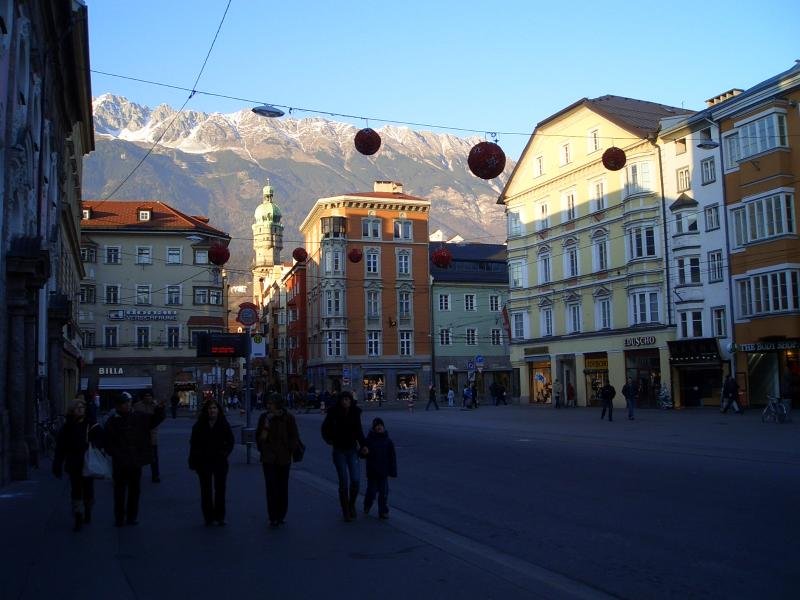
Innsbruck is not just a ski town. It is the capital of Tyrol, a proper city of over 100,000 people wedged into a narrow valley beneath some of the most dramatic mountain scenery in the Alps. The Nordkette range rises directly behind the Altstadt, so steep and close it feels like a painted backdrop. You can ride a cable car from the city centre to 2,300 metres in twenty minutes.
The city has real depth beyond its slopes. Two Winter Olympics (1964 and 1976) left behind excellent sports infrastructure, but Innsbruck was a seat of Habsburg power long before anyone thought of strapping planks to their feet. Emperor Maximilian I made it his favourite residence around 1500, and Empress Maria Theresa reshaped it in the mid-1700s and built the Hofburg Palace. The Old Town's centrepiece is the Golden Roof, a balcony covered in 2,657 gilded copper tiles built so Maximilian could watch tournaments in the square below. The Hofkirche nearby contains his extraordinary bronze cenotaph flanked by 28 larger-than-life statues.
The skiing is genuinely good. Six areas sit within an hour of town, all covered by a single lift pass, and a free shuttle runs from the main train station. The terrain suits intermediates best, but the runs at Hafelekar and the Stubai Glacier will challenge anyone. Beyond winter, the mountains offer hiking, climbing, and mountain biking through the summer months.
What makes Innsbruck work as a destination is the combination. You ski or hike in the morning, then walk cobbled streets past baroque churches and good museums — the Tyrolean Folk Art Museum and the Ferdinandeum both punch above their weight — in the afternoon. The university keeps the city young and the bar scene lively. It is considerably cheaper than the big-name Swiss resorts, and considerably more interesting than a purpose-built ski village.