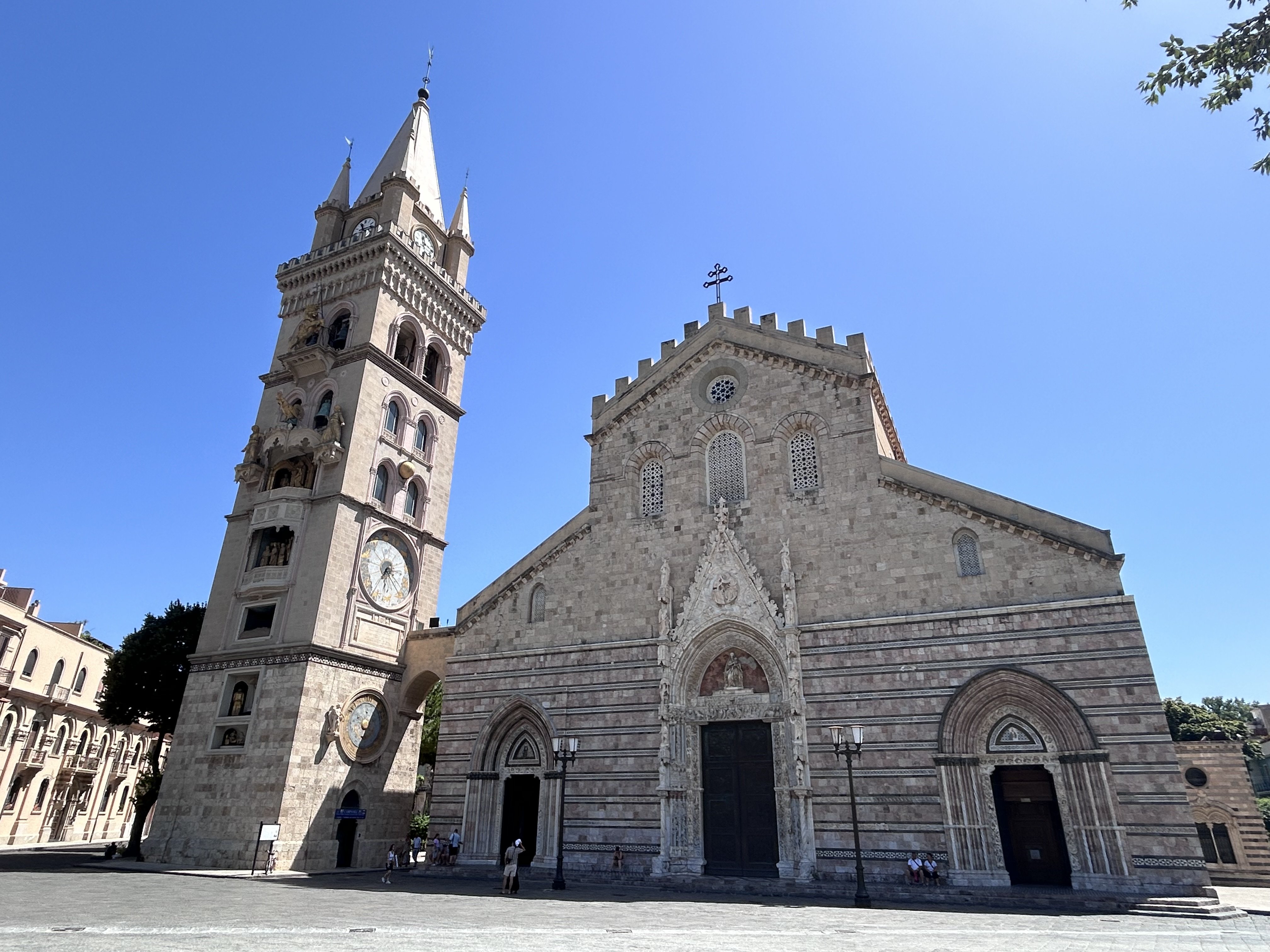
Messina is the gateway to Sicily, the first city you see when crossing the Strait from the mainland by ferry. It sits on one of the most strategically important waterways in the Mediterranean, and has been fought over, shaken, and rebuilt more times than almost any city in Europe. A catastrophic earthquake in 1908 killed tens of thousands and flattened the old city, and Allied bombing in World War II finished what the earthquake started. As a result, Messina lacks the layered historic centre you find in Palermo or Catania.
Most travellers pass through quickly on their way south, but the city deserves at least a few hours. The Duomo, originally built by the Normans in the twelfth century and reconstructed after both the earthquake and the war, houses one of the world's largest and most elaborate astronomical clocks. At noon each day, the clock's mechanical figures spring to life in a fifteen-minute show that draws crowds to the piazza. The Museo Regionale holds works by Caravaggio and Antonello da Messina, the great Renaissance painter who was born here.
The Strait of Messina is famous for its swordfish, and the city is one of the best places in Italy to eat it. The traditional preparation is involtini di pesce spada -- thin rolls of swordfish stuffed with breadcrumbs, capers, and pine nuts. You will find it at trattorias throughout the city, especially near the harbour. The waterfront itself offers fine views across to Calabria, just three kilometres away, and the ferry crossing remains one of the great short sea voyages in Europe.