Gdansk is one of the most historically loaded cities in Europe — and one of the most beautiful. It was here, on 1 September 1939, that the Second World War began, with German guns opening fire on the Polish garrison at Westerplatte. And it was here, in 1980, that Lech Walesa climbed over the fence of the Lenin Shipyard and the Solidarity trade union was born — the movement that would eventually bring down communist rule across Eastern Europe. Two of the defining events of the twentieth century, in the same city. The European Solidarity Centre, opened in 2014 on the old shipyard site, is essential viewing.
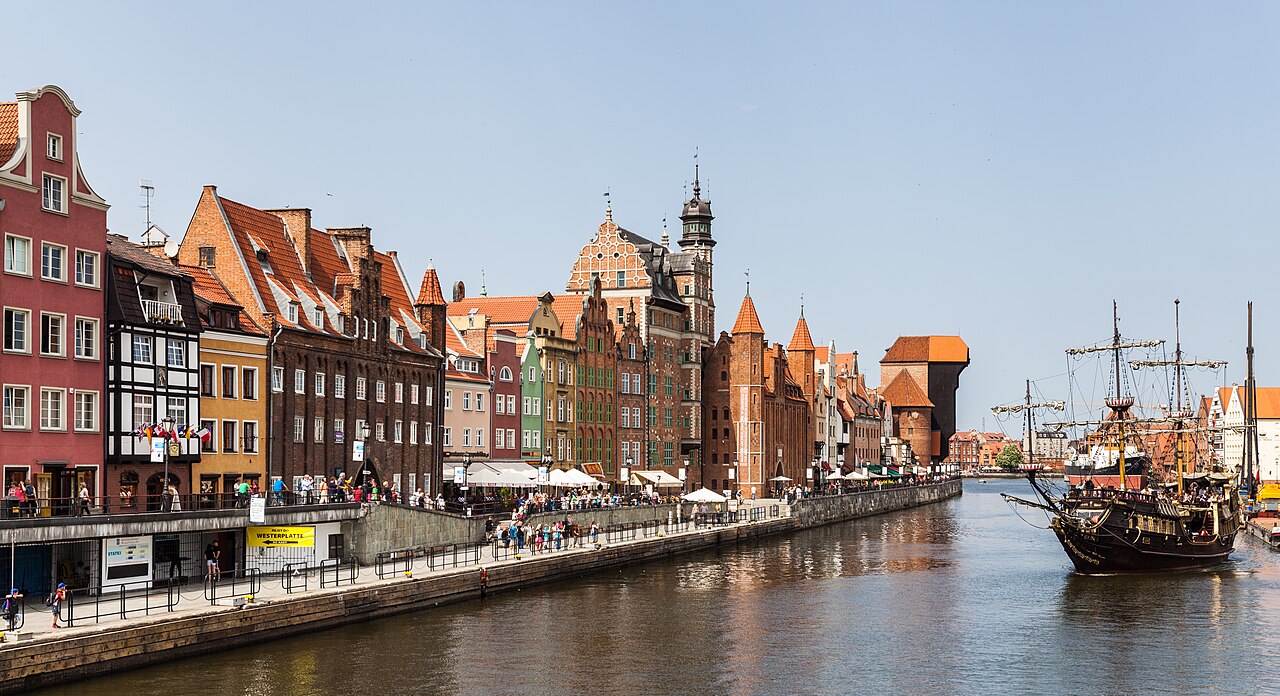
The old town is a revelation. Virtually every building was destroyed in the fighting of 1945, yet the Poles rebuilt it all — the tall burgher houses along Dluga Street, the Gothic towers, the merchant facades leaning over the Motlawa River — stone by stone, from old engravings and photographs. What you see today is a reconstruction, but it is a strikingly beautiful one, and the scale and detail of the effort give it its own kind of emotional weight.
The Royal Way runs from the Upland Gate through the Golden Gate and along Dluga Street to the Long Market, a sequence of set-pieces that few European city centres can match. The Neptune Fountain presides over its centre, backed by Artus Court. Beyond it, Mariacka Street — lined with amber shops and outdoor cafes — leads to St Mary's Church, the largest brick church in the world. The waterfront along the Motlawa is marked by The Crane, the largest medieval port crane in Europe, now part of the Maritime Museum. The Great Armoury nearby is one of the finest Renaissance buildings in Poland.
Gdansk is also the gateway to the Tri-City (Trojmiasto): the elegant resort of Sopot to the north, and Gdynia beyond it, with its interwar modernist architecture and working port. All three are connected by frequent commuter rail and easy to explore in a day or two.