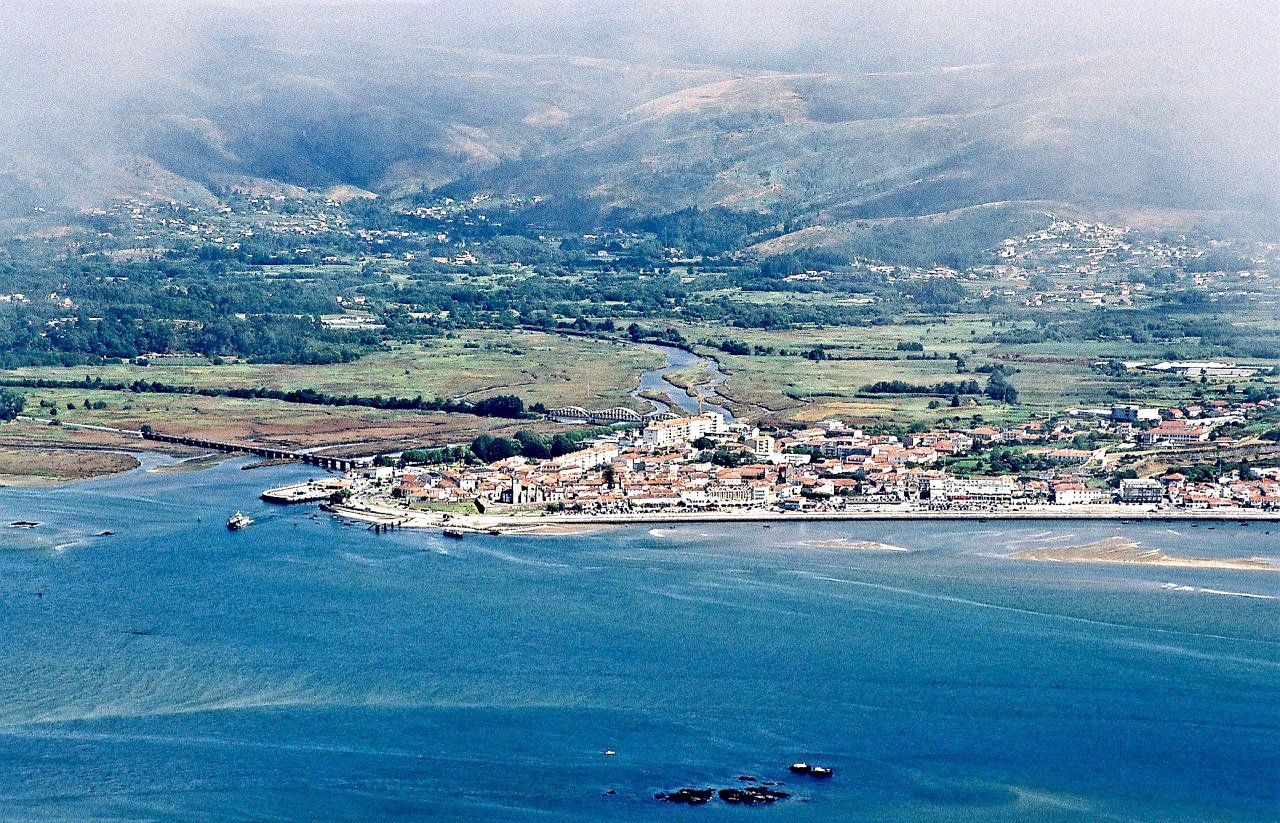
Portuguese border town where the Minho meets the Atlantic, centred on a granite square and fortified clock tower.
Caminha is the northernmost town on the Portuguese coast, the place where the country runs out and the Minho river becomes the border with Spanish Galicia. From Porto the road and the railway both follow the coast and then the river up to this point and stop. There is something appealing about an end-of-the-line town: the square is small and lively, the granite is grey, and the river is broad and slow.
The old centre is built around a single handsome square, the Praça Conselheiro Silva Torres, framed by a fortified medieval clock tower and a sixteenth-century Renaissance fountain. A few steps east stands the Igreja Matriz, a late-Gothic parish church with an extraordinary Mudéjar wooden ceiling that is the single best reason to step inside any building in town.
The other reason to come is the river. A small ferry crosses to A Guarda in Spain — a ten-minute crossing that ends at one of the better seafood ports in Galicia. The boat sets out from the quay just below the old town and is at its most appealing in late afternoon, with the lights of both shores just coming on. The same stretch of riverbank makes an excellent setting for a long meal if you are waiting for the last train back to Porto.
Caminha is a half-day town for most travellers, or an overnight stop on a slow coastal route between Porto and Galicia. Either way, it rewards a slower pace than its size might suggest.
Guide
Eating Out
Caminha sits at the mouth of the Minho, which means river fish on the menu — particularly lamprey (lampreia) in late winter and shad (sável) in spring. The local treatment of lamprey is a thick, dark rice dish (arroz de lampreia) which is heavy but excellent in the cold months. Outside lamprey season, look for grilled river bass, monkfish rice, and the local bacalhau à minhota (salt cod with onions and potatoes).
Restaurants line the riverside and the streets around the main square. Most are family-run and prices are well below those in Porto or Viana do Castelo. The lunch menu do dia — usually a soup, a fish or meat plate, a drink, and coffee — is excellent value.
Guide
Getting There
Caminha is at the end of the line — literally. The Linha do Minho train from Porto's Campanhã station runs north along the coast and ends at Valença on the Spanish border, passing through Caminha. The journey from Porto takes about two hours; from Viana do Castelo about 30 minutes.
By road, the A28 motorway runs along the coast from Porto and exits a few kilometres inland of Caminha. Buses from Porto and Viana do Castelo also serve the town, though less frequently than the train.
From Spain, the most pleasant approach is the small ferry from A Guarda in Galicia (see Ferry to A Guarda). Otherwise, the international bridge at Valença is twenty kilometres upstream.
Guide
When to Go
Spring and early autumn are the best times: clear, mild, with the riverside green and not too many people. Summer (July and August) brings Portuguese holidaymakers and Galician day-trippers, and the place can feel surprisingly busy for its size — though never overwhelming.
Winter is wet. The Minho valley catches the Atlantic weather and rain is frequent from November through February. The compensation is the lamprey season: from mid-January through about the end of March, restaurants put it at the top of their menus and Spanish food enthusiasts cross the river to eat it.
The Festa de Santa Rita de Cássia in late May brings processions and music to the streets. The Festival Vilar de Mouros, a few kilometres inland, runs over four days in August.