Besalú
©
Besalú

Besalú

Medieval Catalan town above the Fluvià, entered by a fortified Romanesque bridge and old Jewish quarter

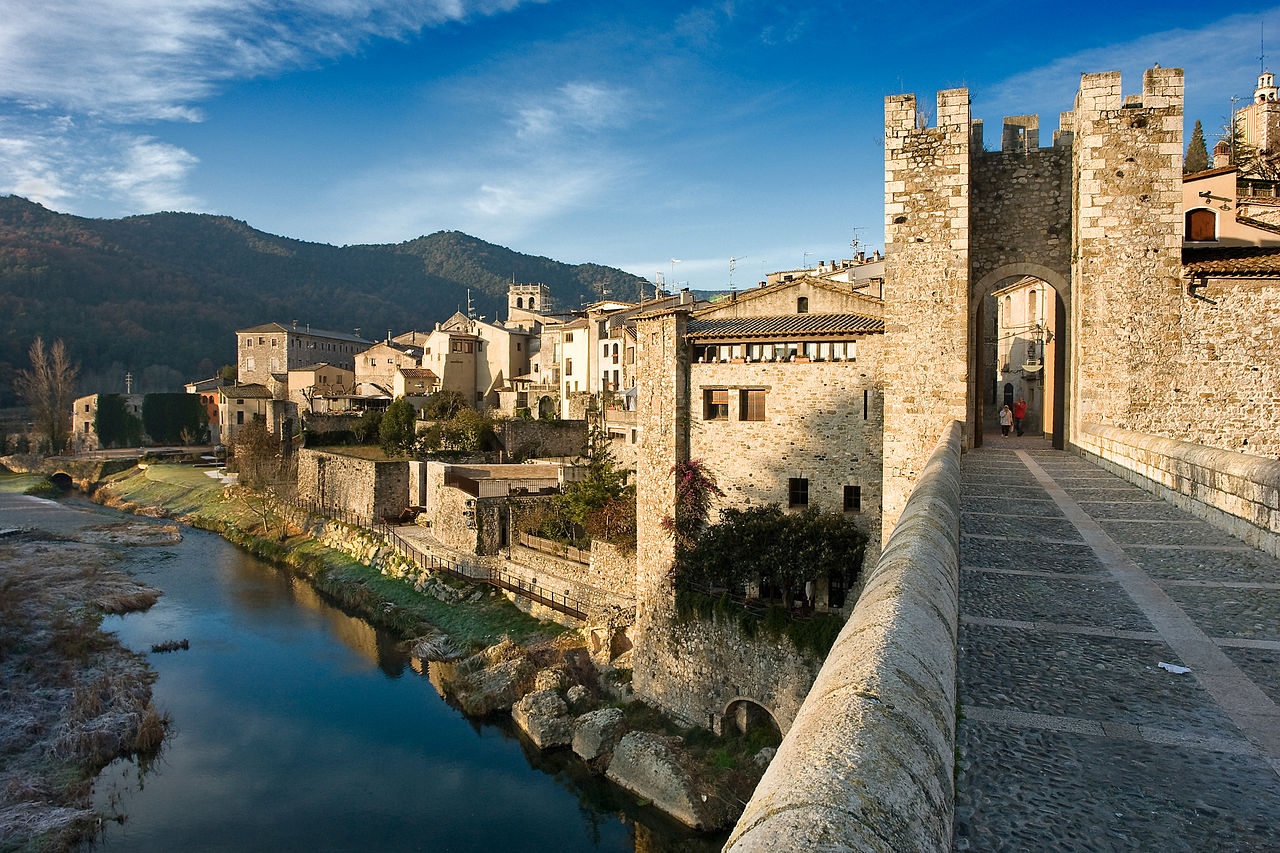
Besalú is one of Catalonia's finest medieval towns — almost entirely intact, clustered on a rise above the Fluvià river. The moment you cross its fortified Romanesque bridge into the old quarter, it feels less like a tourist attraction than a place where the 12th century simply hasn't been cleared away.

The fortified bridge (Pont Fortificat) is the centrepiece: a crenellated structure with a gatehouse and a doglegged approach that forced any attacker to slow down. Beyond it, the streets lead through a compact tangle of stone buildings to a handsome Romanesque church and the remains of a Jewish quarter — Besalú had a significant Jewish community in the Middle Ages, and the restored mikveh (Jewish ritual bath) beneath the city is one of the best preserved in Spain.

You can reach Besalú by bus from Girona via Banyoles. The town is small enough to explore fully on foot in two or three hours.

Guide

Bars and Cafes

Besalú is overwhelmingly a daytime destination — most visitors are day-trippers, and the evening scene is limited. What the town does well is the morning café stop: coffee and something to eat before the tour groups arrive, when the streets are quiet and the bridge is yours.

A handful of cafés cluster around the main square and along the main street. The evening options are thin; if you're staying overnight, the restaurants are your best bet for a drink after dinner.

Guide

Books

Barcelona by Robert Hughes (1992) — the art critic's account of Catalan history and culture through its art and architecture. Dense and opinionated, it gives Catalonia's particular identity a depth that makes the Romanesque churches and the medieval quarters mean more. Hughes has no patience for the picturesque; he wants you to understand what you're looking at.

Homage to Barcelona by Colm Tóibín (1990) — a personal, literary portrait of the city and the region written in the aftermath of Franco. Tóibín travels from Barcelona into the Catalan countryside and pays sustained attention to what Catalan identity means in practice. A good companion for anyone travelling beyond the capital.

Voices of the Old Sea by Norman Lewis (1984) — Lewis spent three years in a fishing village on the Costa Brava in the late 1940s, and this account of traditional coastal life is one of the best things written about Spain in the 20th century. The Catalonia he describes — poor, suspicious, tenacious — is not the Catalonia of the tourist brochures, and is all the more valuable for it.

Romanesque Art in Catalonia — several academic editions exist. Catalonia has one of the densest concentrations of Romanesque architecture in Europe, and a compact reference guide to the style — what makes a double apse unusual, why the bell towers look the way they do — sharpens the eye considerably in towns like Besalú.

Guide

Day Trips

Besalú sits in good day-trip territory. Banyoles (12km) is the most natural pairing — a handsome lake town on the same bus route from Girona, easy to combine into a single day without a car. The lake is one of the largest natural lakes in Spain and the setting is lovely.

Girona (35km) is the obvious base for the area and well worth its own visit: a Jewish quarter that rivals Besalú's for depth of history, a Gothic cathedral with a spectacular single nave, a well-preserved medieval wall circuit, and a Rambla that functions as the town's living room.

Olot (20km west) is the capital of the Garrotxa volcanic zone. The town itself is pleasant if unremarkable, but the Parc Natural de la Zona Volcànica de la Garrotxa immediately outside it — a landscape of wooded volcanic cones — is one of the more unusual landscapes in Catalonia, and the volcanic soil is the reason local vegetables taste the way they do.

Sant Joan de les Abadesses (45km) has a fine Romanesque monastery with an exceptional 13th-century Descent from the Cross — a group of polychrome figures that is one of the great works of medieval Catalan art.

Guide

Eating Out

For a small town, Besalú has a respectable range of restaurants. The cuisine is Catalan throughout — hearty stews, good charcuterie, grilled meat, and local wine. One advantage of the location: the volcanic soil of the Garrotxa region immediately to the west produces exceptional vegetables, and several restaurants make a point of using them.

The most atmospheric option is a terrace with a view toward the bridge. Book ahead on weekends in summer, when the town fills with day-trippers from the coast.

Guide

Getting Around

Besalú requires no transport at all. The entire old quarter is walkable, and the bridge, the mikveh, the church, and the main square are all within ten minutes of each other on foot. The streets are uneven stone — comfortable shoes are worth thinking about.

Parking is available in the lots outside the old walls. Cars are not permitted in the historic centre.

Guide

Getting There

By bus: Regular buses run from Girona to Besalú via Banyoles, taking around one hour. There are several departures daily; check the current timetable with the local operator. The bus stop is close to the bridge.

By car: Besalú is 35km from Girona on the C-66 — about 40 minutes. From Barcelona it's around 130km, roughly 90 minutes depending on traffic. Park outside the old walls; the historic centre is effectively pedestrian.

By air: Girona–Costa Brava Airport (GRO) is the nearest airport, around 50km away. Barcelona El Prat (BCN) is 140km.

Guide

Things to Do

Besalú is one of Catalonia's most complete medieval towns, and almost everything worth seeing is packed into a compact old quarter that takes two to three hours to cover on foot. There are no museums to speak of — the town itself is the exhibit.

The three essential sights are the fortified bridge (Pont Fortificat), the mikveh, and the Romanesque church of Sant Pere. The bridge is unmissable; the mikveh requires a short guided visit booked at the tourist office but is well worth the effort; and the church is free to enter when open. Beyond these, the medieval streets reward slow wandering — Romanesque houses, ruined churches, and the old Jewish quarter are all within a few minutes of each other.

For a full day, combine Besalú with Banyoles, a handsome lake town 12km away on the same bus route from Girona.

Guide

When to Go

Spring (April to June) and autumn (September to October) are the best times to visit — the weather is good, the light is warm, and the crowds are manageable. July and August bring summer tourists from the Costa Brava and Barcelona, but the medieval streets are dense enough to absorb them; it's busy rather than overwhelming.

Weekday mornings are the least crowded at any time of year. The tour buses typically arrive mid-morning; if you get there early, you'll have the bridge largely to yourself.

The Mercat Medieval (Medieval Market), held over a long weekend in mid-September, is Besalú's major annual event. The town dresses in period costumes, the streets fill with market stalls selling crafts and food, and there is music and re-enactment throughout. It draws large crowds but is genuinely good — the setting is built for it.