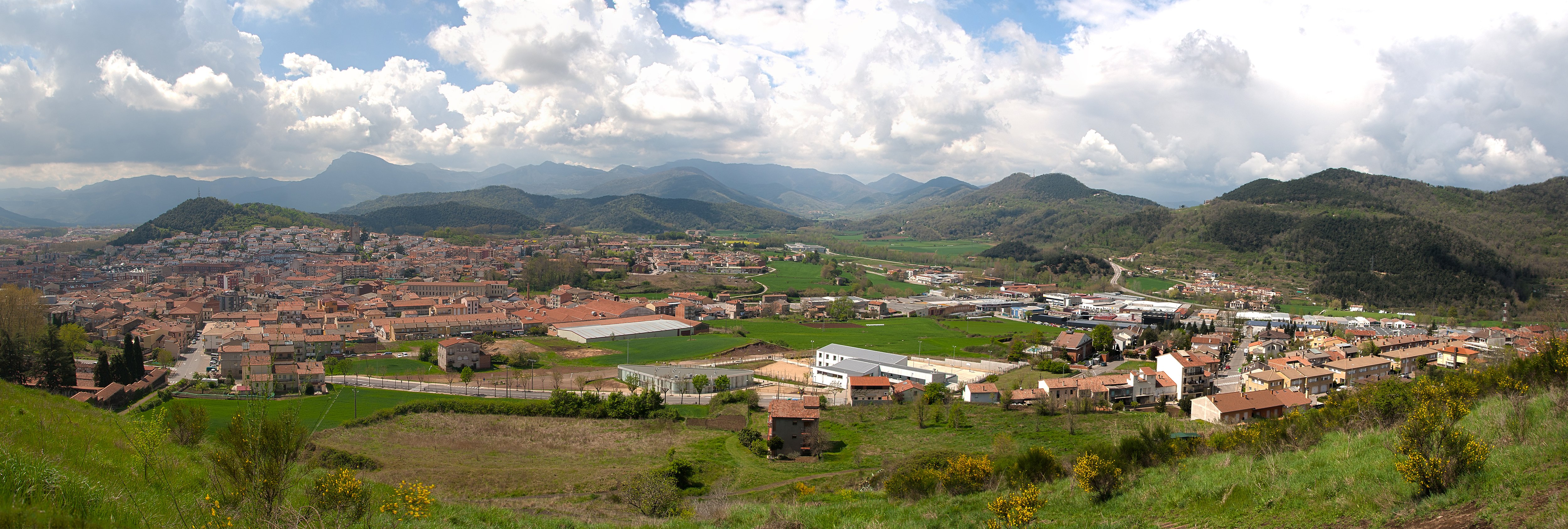
Olot is not an obvious volcanic landscape. The volcanoes are extinct — the youngest erupted around 11,000 years ago — and the Garrotxa plateau is deeply green, densely forested, and thoroughly farmed. But the shapes of the land give it away: smooth, symmetrical cones rising from the valley floors, craters filled with beech or oak, lava fields that created soils of unusual fertility. The Zona Volcànica de la Garrotxa contains more than forty volcanic cones and twenty-eight documented lava flows, making it the best-preserved volcanic landscape in the Iberian Peninsula, and walking through it in autumn, when the beeches turn, is an experience that stays with visitors long after they have left.
The most celebrated feature of the Garrotxa is La Fageda d'en Jordà — a beech forest that grows on a lava field left by the Croscat volcano, its root systems threading through the blocky basalt in a way that produces a dense, almost parklike grove quite different from the surrounding scrubland. The Catalan poet Joan Maragall wrote about this forest in 1906, and it remains something of a Catalan literary landmark. The Croscat volcano itself, just outside the village of Santa Pau, was partially excavated for volcanic cinders in the 20th century, leaving an exposed cross-section of the cone that allows visitors to read the eruption sequence directly from the rock layers. The neighbouring Santa Margarida volcano, with its grass-filled crater and Romanesque chapel, is the other star site. The Museu dels Volcans in Olot explains the science, and the natural park's information center in Santa Pau organizes the walking routes.
The city of Olot has its own character beyond its geological setting. There is even a volcano, the Montsacopa, inside the town itself. The Escola d'Olot — the 19th-century landscape painting school that emerged here in response to the distinctive local light and scenery — produced artists whose work helped define Catalan visual culture; their pictures hang in the Museu de la Garrotxa. Catalan cuisine in the Garrotxa leans heavily on locally grown ingredients: buckwheat (fajol) reappears in crêpes and salads, and the local butchers produce sausages and charcuterie — especially butifarra and llonganissa — of serious quality, all of it best sampled at the Michelin-starred Les Cols. The medieval village of Santa Pau, with its perfectly preserved porticoed square, is a short drive and among the most photogenic places in northern Catalonia.