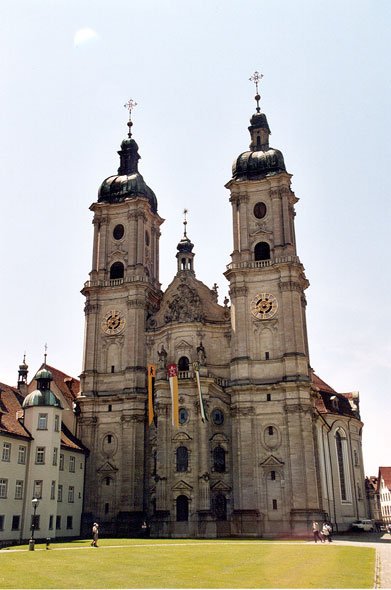
Saint Gallen is a small city in northeastern Switzerland that punches well above its weight in cultural and historical terms. It grew up around a Benedictine monastery founded in the 7th century by the Irish monk Gallus, and the Abbey of Saint Gall that developed from that foundation became one of the most important centres of learning in medieval Europe. The abbey precinct — cathedral, abbey library, and surrounding buildings — is a UNESCO World Heritage Site and the main reason visitors come here.
The Abbey Library is exceptional even by Swiss standards for preserving historic institutions. One of the oldest libraries in the world still in use, it holds manuscripts dating back to the 8th century, including the oldest surviving architectural drawing in the world — the Plan of Saint Gall, a detailed schematic for an ideal monastic complex drawn around 830. The Baroque reading room alone, with its gilded galleries and painted ceiling, is worth a visit.
Beyond the abbey, Saint Gallen is a prosperous city with a well-preserved medieval centre. The old town has many fine examples of the oriel windows — the elaborate bay windows projecting from upper floors — that are characteristic of eastern Swiss merchant architecture. The city made its money from embroidery and textiles, and the Textile Museum tells that story well. The city is also the capital of its canton and home to the University of St. Gallen, one of Europe's leading business schools.
Saint Gallen makes a comfortable day trip from Zurich, about 80 minutes by train, or a base for exploring Lake Constance and the Appenzell region to the south.