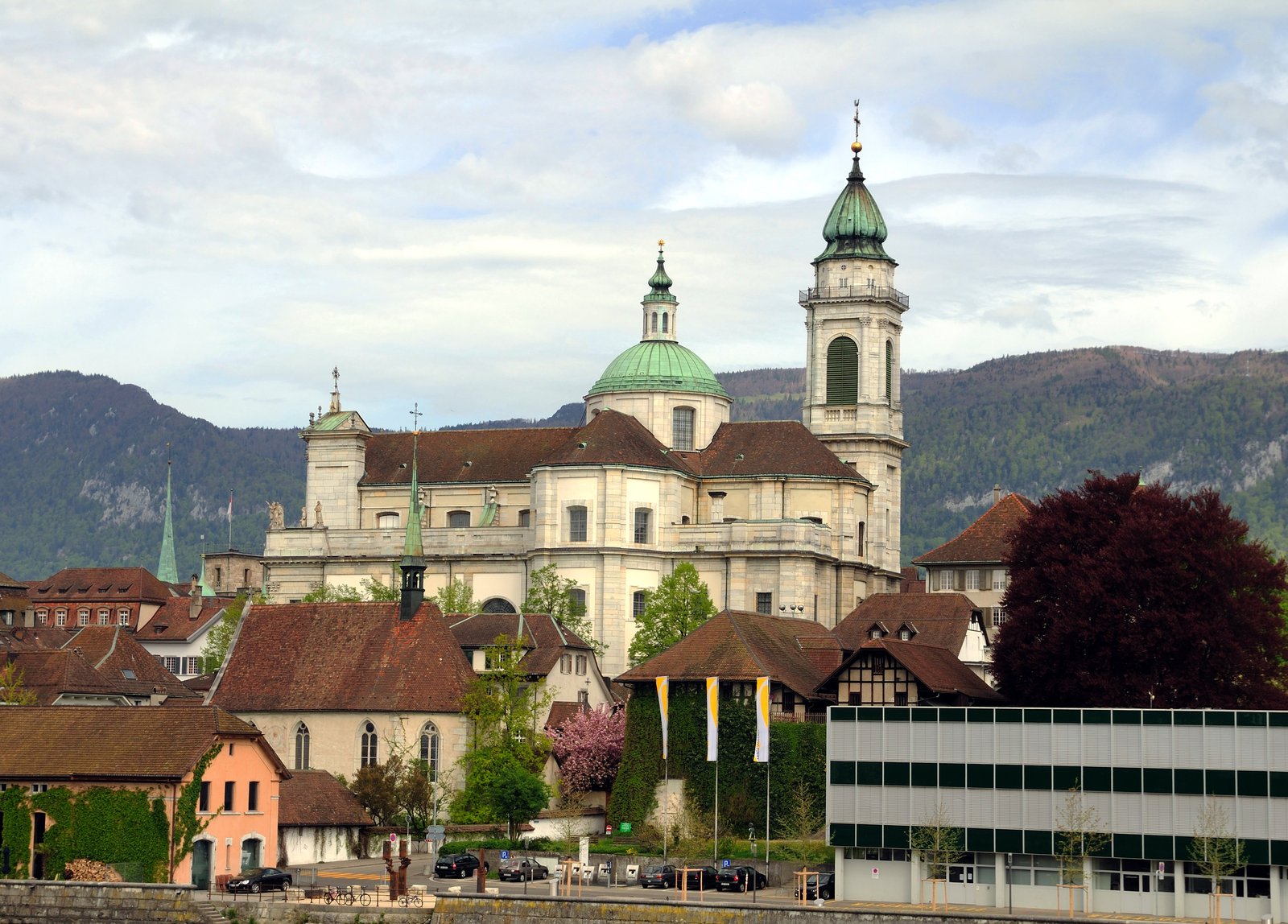
Solothurn is a small city on the Aare with one of the best-preserved Baroque old towns in Switzerland. Its obsession with the number eleven — eleven churches, eleven chapels, eleven fountains, eleven towers, all relating to the city's foundational mythology — is either endearing or peculiar depending on your disposition, but the Cathedral of Saint Ursus rising above the rooftops makes a strong case for the former. Built between 1762 and 1773, it is one of the finest Baroque buildings in the country.
The old town is compact and largely pedestrianised, with Baroque facades, carved stone fountains, and the medieval gates of the Bieltor and Baseltor marking the edges of the historic centre. The ambassadors of France maintained a residence here for two centuries — Solothurn was the seat of the French ambassadors to the Confederation from 1530 to the French Revolution — and this foreign money funded much of the Baroque building programme that gives the city its character today.
The Kunstmuseum Solothurn holds a collection built around a remarkable bequest: the Dübi-Müller collection, which included several key works by Ferdinand Hodler and a group of Impressionist paintings that gave the museum an international profile. The Museum Altes Zeughaus — the old armoury — is one of the largest collections of historical armour and weapons in Switzerland.
Beyond the town, the Verena Gorge to the northwest offers a striking walk through a narrow limestone canyon to a medieval hermitage. Solothurn is 30 minutes by train from Bern and a straightforward day trip, but it deserves at least a full day.