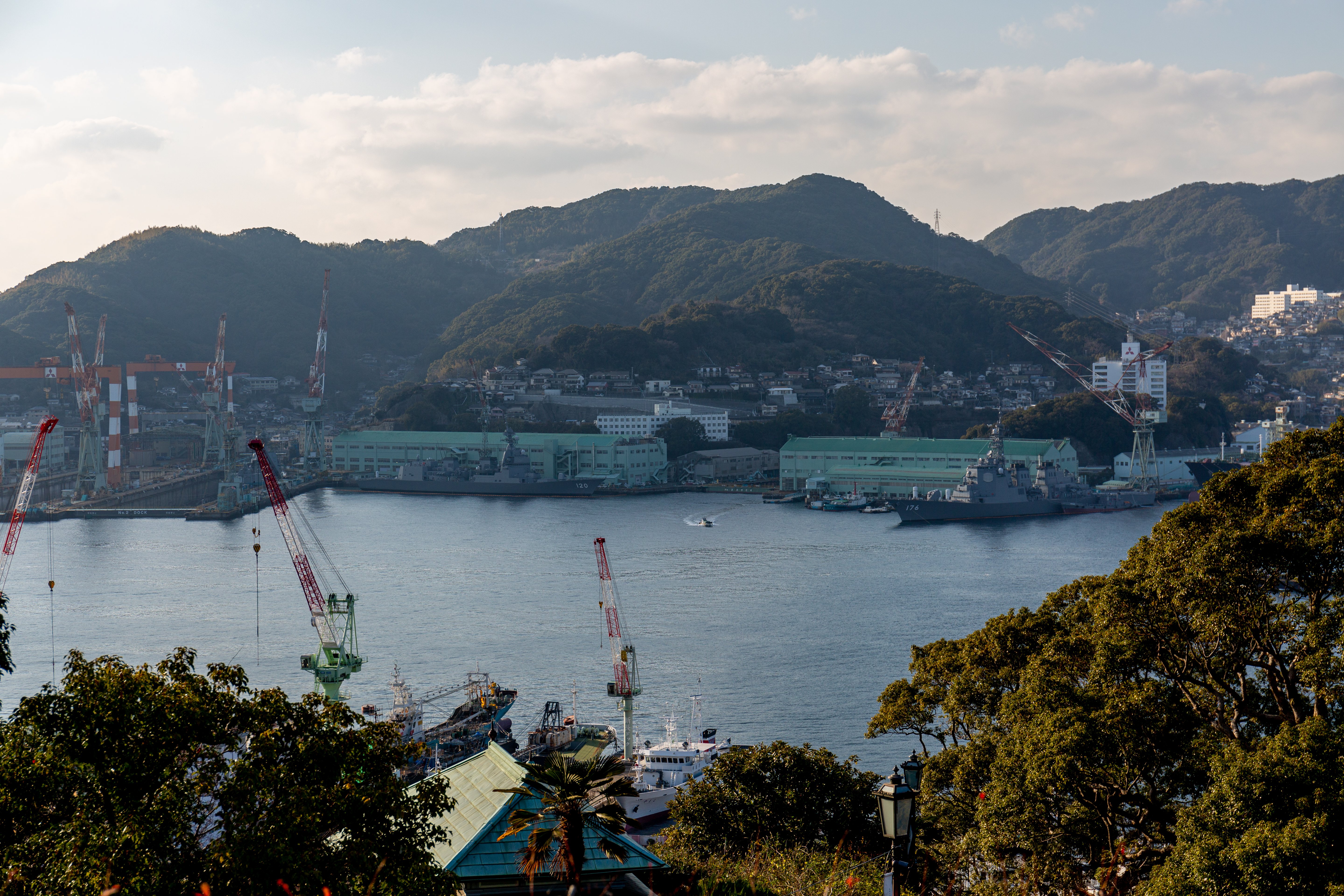
Nagasaki sits at the head of a long harbour on Kyushu's western coast, and for more than two centuries it was Japan's only window to the outside world. During the Edo period, when the rest of Japan was closed to foreign contact, a tiny artificial island called Dejima in Nagasaki harbour was the sole place where Dutch traders were permitted to operate. Chinese merchants had their own quarter nearby. This long history of foreign contact gives the city a character unlike anywhere else in Japan — European, Chinese, and Japanese influences are layered throughout.
On 9 August 1945, the city was struck by the second atomic bomb. The Nagasaki Atomic Bomb Museum and the Hypocenter Park in the Urakami district are sombre and deeply affecting. The rebuilt Urakami Cathedral, originally the largest cathedral in East Asia, stands nearby.
Beyond the atomic history, Nagasaki rewards exploration. Glover Garden, perched on a hillside above the harbour, preserves Western-style residences from the Meiji era — the Glover House is the oldest surviving Western building in Japan. Dejima has been partially reconstructed as a museum of the Dutch trading post. The city's Chinatown, one of the oldest in Japan, is compact and lively. The row of Chinese-style Buddhist temples — Sofuku-ji, Kofuku-ji, and Fukusai-ji — along the Nakashima River are distinctive, each built by Chinese merchant communities in the 17th century. The river itself is crossed by a series of stone bridges, of which the Megane-bashi (Spectacles Bridge) is the most famous.
The Maruyama entertainment district has been the centre of Nagasaki's nightlife for centuries. It is more restrained now than in its heyday, but it remains the best area for an evening out.