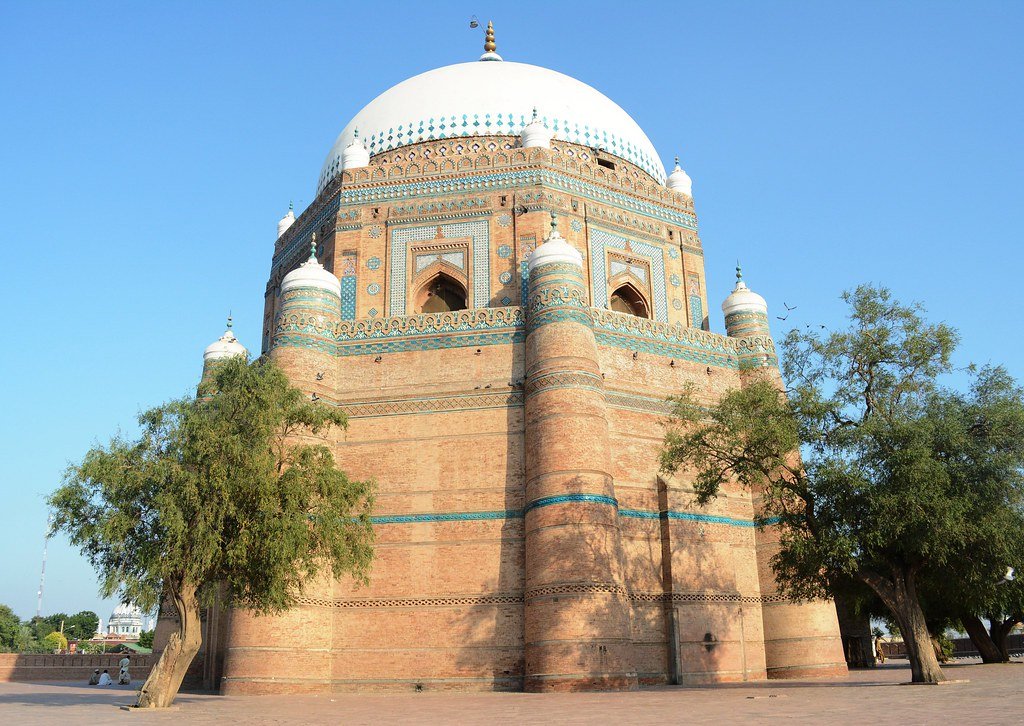
Multan is one of the oldest cities in South Asia and one of the most important in Pakistan — a place whose history runs continuously from the bronze age to the present day. It was conquered by Alexander the Great in 326 BCE, by the Umayyad general Muhammad bin Qasim in 712 CE (making it one of the earliest Islamic cities of the subcontinent), by Mahmud of Ghazni, the Mughals, the Sikhs, and finally the British. Every one of them left its mark. Today it is a busy, hot, dusty city of around two million people on the Chenab River in southern Punjab, known across Pakistan as the "City of Saints" (Madinat-ul-Awliya) — a reference to the dozens of Sufi shrines that dot its skyline.
The most important of those shrines are the tombs of the Suhrawardiyya order of Sufis, whose 13th- and 14th-century masters are buried beneath domes that dominate the old city. The Shrine of Shah Rukn-e-Alam — a vast octagonal brick-and-tile mausoleum on the old fort mound, 51 feet across and 115 feet tall, built in 1320 — is the architectural high point and considered one of the great examples of pre-Mughal Tughluq architecture. Next to it, the Shrine of Bahauddin Zakariya, his grandfather, is older still. Together they are the heart of Multan's religious life; both are active pilgrimage sites, particularly during the annual urs festivals of the saints. Other important shrines include those of Shah Shams Tabrez (east of the old fort) and Shah Yusuf Gardezi (inside Bohar Gate).
Of the city's old mosques, the most important surviving ones are the Eidgah Mosque of 1735, the Mosque Ali Muhammad Khan in the crowded bazaar, and the abandoned Sawi Mosque (probably the oldest in the city). The Multan Fort itself — once an enormous complex on a raised mound above the old town — was destroyed by the British garrison in 1848 and only its foundations survive. The old walled city around the fort, entered through the Lahore Gate, Bohar Gate and Haram Gate, is a tangle of narrow lanes, bazaars selling the famous blue-and-white Multani pottery and Multani khussa leather slippers, and excellent street food. A worthwhile stop for anyone interested in Islamic architecture and Sufi heritage.