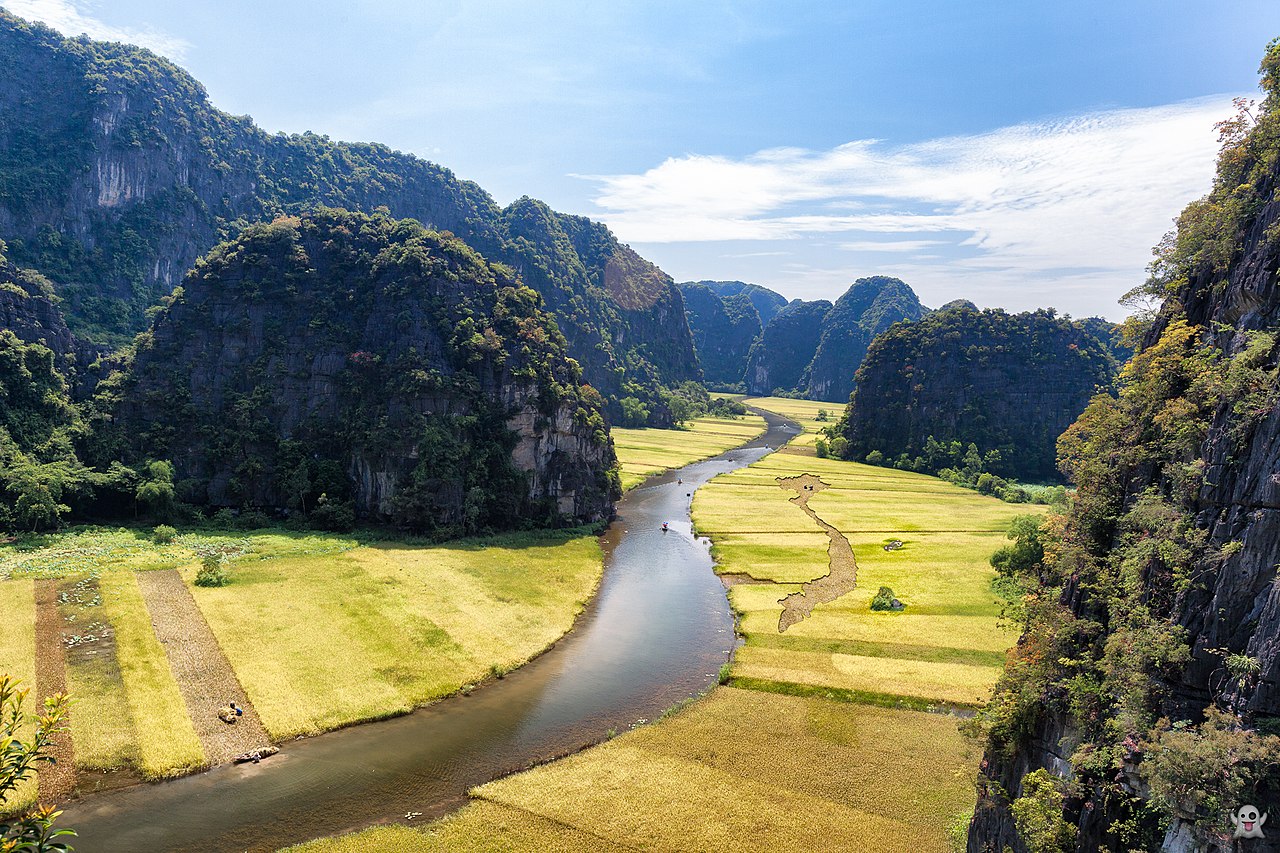
Ninh Binh is where Vietnam goes vertical. The province sits 90 km south of Hanoi and is carpeted with limestone karst towers — the same dramatic geology as Ha Long Bay, except here the peaks rise from rice paddies and slow rivers instead of ocean. The effect is extraordinary: boats drift between cliffs, egrets stalk through flooded fields, and Buddhist temples cling improbably to cliff faces above it all.
The centrepiece is Trang An, a UNESCO World Heritage site where a boat circuit takes you through dozens of tunnel caves carved by rivers, across flooded valleys, and past ancient Buddhist shrines. It takes two to three hours and feels genuinely wild. A few kilometres away, Tam Coc is smaller and more touristed but still beautiful — boats row through three river caves with limestone peaks rising from the rice paddies on either side. The Bich Dong Pagoda above Tam Coc is easily combined with the boat trip.
Hoa Lu, the fortified capital of Vietnam's first independent dynasty in the 10th century, is now a peaceful complex of temples in a valley ringed by mountains. Mua Cave nearby involves a steep 500-step climb to the best panoramic viewpoint in the province.
Cuc Phuong National Park, about 45 kilometres northwest, is Vietnam's oldest national park and the easiest place in the country to see endangered primates up close. Phat Diem Cathedral, near the coast to the south, is a remarkable hybrid of Vietnamese and European ecclesiastical architecture built in the 1890s entirely from local stone.
Ninh Binh City itself is unremarkable, but it is a perfectly functional base. Most visitors doing a Ha Long Bay alternative base themselves here for a night or two and find it far quieter and cheaper than the coast.