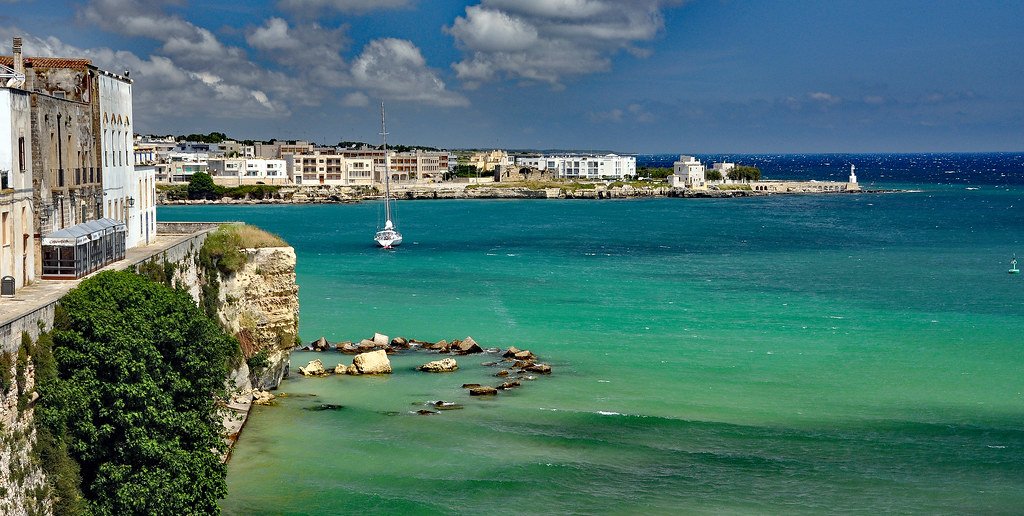
Otranto sits at the very tip of Italy's heel, on the Adriatic coast of Puglia — closer to Albania across the channel than to Rome. It is one of the most historically layered towns in southern Italy: Greek colonists founded it, Byzantines fortified it, Normans conquered it, and in 1480 Ottoman forces under Mehmet II sacked the city and massacred its inhabitants. The bones of the 800 martyrs killed that year still line the walls of the cathedral in one of the most striking ossuary displays in Europe.
The historic centre is compact, walled, and immensely charming — narrow whitewashed lanes, brightly painted doorways, and a harbour that has hosted crusaders, merchants, and invaders for two thousand years. The Cathedral, built between 1080 and 1088, contains a remarkable 12th-century mosaic floor covering the entire nave: a medieval Tree of Life populated with biblical figures, mythological beasts, knights, and peasants. It is one of the finest Romanesque mosaics in existence.
The Aragonese castle, built by Ferdinand of Aragon between 1485 and 1498, commands the harbour with cylindrical corner towers and a traditional moat. The town beaches, with their transparent Adriatic water, are among the best on the Salento coast — try Baia dei Turchi for the finest sand. Otranto is a natural base for exploring Capo d'Otranto — the easternmost point of the Italian mainland — and the wetlands of the Laghi Alimini to the north.