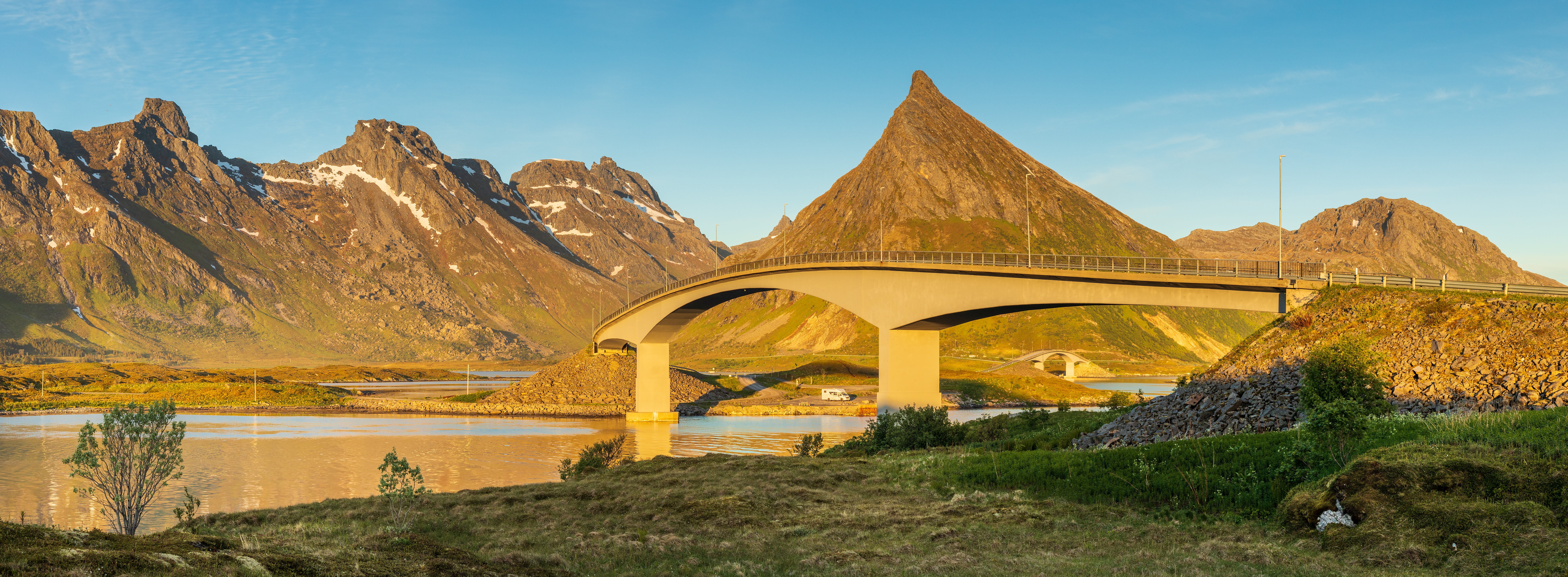
Flakstad is one of the quieter municipalities of the Lofoten Islands, occupying Flakstad Island and the northern tip of Moskenes Island. The outer edge, facing the Arctic Ocean, is where most people live — in fishing hamlets with white-sand beaches, weathered wooden churches, and a pace of life that feels genuinely unhurried. The E10 highway, officially named King Olav V's Road, threads through the municipality on its way south-west.
The name may derive from the Norse word for "cliff", though the island's older name, Vargfot ("wolf's paw"), gives a better sense of the dramatic terrain. The strait of Sund divides the municipality in two — at its narrowest, it is barely wide enough for two fishing vessels to pass.
Ramberg is the administrative centre, set beside a beautiful white beach facing the Arctic Ocean. The historic Flakstad Church (1780), built from timber with a distinctive onion cupola, stands just outside the village. The altarpiece predates the building itself.
Nusfjord is Flakstad's most celebrated village — a cluster of traditional fishermen's huts chosen in 1975 as one of three European pilot projects for the preservation of original Norwegian building customs. Some huts are still used by fishermen in winter and let to tourists in summer.
Vikten is worth a stop for its glassblower's cabin and Åses Pottery, both open for sales. A pebble beach looks out to the open sea.
Sund is an old fishing hamlet with a museum of boat engines — some of which still run — and the workshop of a blacksmith famous for handmade cormorant sculptures.
Østre Nesland is an abandoned fishing and farming village accessible on foot from Napp via the Flakstad trail, passing Storbåthallaren, a Stone Age settlement. Along the way you pass Skjelfjord, which sheltered British warships during the 1940 Battle of Narvik.
Fredvang, on the northern part of Moskenesøy, is the departure point for hikes to the wild outer coastline called Yttersida — including Kvalvika Beach and the summit of Ryten. The Draug Festival takes place here in July.