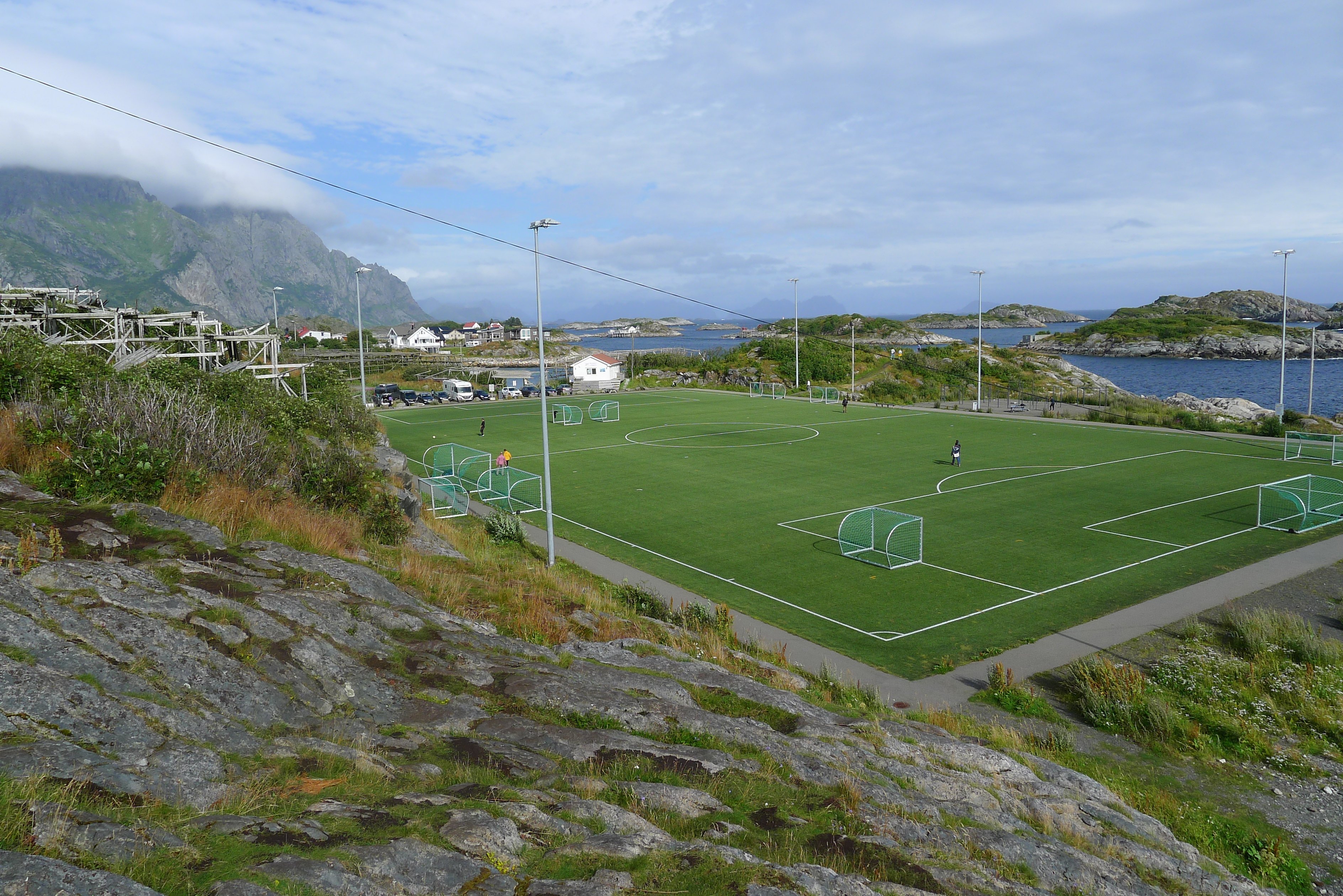
Lofoten fishing village spread across islets beneath Mount Vågakaillen and the Vestfjord
Henningsvær sits at the foot of Mount Vågakaillen, a cluster of isles and islets scattered across the blue waters of the Vestfjord. With mountains at its back and the sea on every other side, it was a natural hub during the Lofoten winter fishery, and in the 1800s the village prospered into one of the most prominent fishing communities in Lofoten.
Unlike many other fishing villages, Henningsvær's population has remained stable in recent years, with over 500 people still living here. The islands were not connected to the rest of Lofoten by bridges until 1983, and that isolation probably saved the community from the concrete-block architecture that blighted most Norwegian towns in the 1960s and 70s. The result is something quite special — a vibrant, working fishing village with well-preserved traditional buildings, a handful of art galleries, and one of the most photogenic football pitches in the world, wedged between rock and sea on a tiny islet.
Rock climbing has put Henningsvær on a different map in recent decades — the granite walls above the village offer some of the best routes in northern Europe, with the Vestfjord spread out below and peaks rising in every direction. The Kaviarfabrikken, a converted fish-processing factory on the harbour, now shows contemporary art in a setting that somehow makes perfect sense. And for history, the village played a small but real role in the Second World War: British and Norwegian commandos raided the harbour during Operation Claymore in 1941, destroying factories supplying Nazi Germany and returning with Enigma machine components.
Guide
Getting There
Henningsvær is about 20 kilometres southwest of Svolvær, the main town in Lofoten and the island chain's transport hub. From Svolvær, the village is reached by car or bus along the E10 highway and a spur road — the journey takes about 25 minutes by car. Buses from Svolvær run several times daily.
Svolvær itself is connected to the mainland by the Lofoten ferry (from Bodø, a three-hour crossing) and by plane — Svolvær Airport has flights to Bodø and other Norwegian cities. The scenic Lofoten road trip from the mainland via the toll road is one of Norway's great drives and passes close to Henningsvær.
There are no accommodation options inside Henningsvær other than a handful of rorbuer (traditional fisherman's cabins) and one or two small guesthouses. Many visitors base themselves in Svolvær or elsewhere and make Henningsvær a day trip, which is easy and gives you plenty of time to see everything.
Guide
When to Go
Henningsvær is accessible year-round, and each season offers something different. Summer (June to August) brings the midnight sun — weeks of continuous daylight that can be disorienting and magical in equal measure. This is peak tourist season, but the village is small enough that it never feels overrun.
Winter is the time for the Northern Lights, which can appear with spectacular intensity over the dark water and snow-covered peaks. It's also the height of the traditional Lofoten winter cod fishery, which runs from January to April — an ancient pattern that shaped everything about the Lofotens and still drives the local economy. Arriving in winter and seeing the wooden cod-drying racks strung with fish, with small boats working the icy fjord, gives you a sense of what this place has been for centuries.
Spring and autumn offer fewer crowds, reasonable weather, and the best chances for good light for photography — the low-angle sun in April and October turns the red and yellow fishing shacks into something extraordinary.