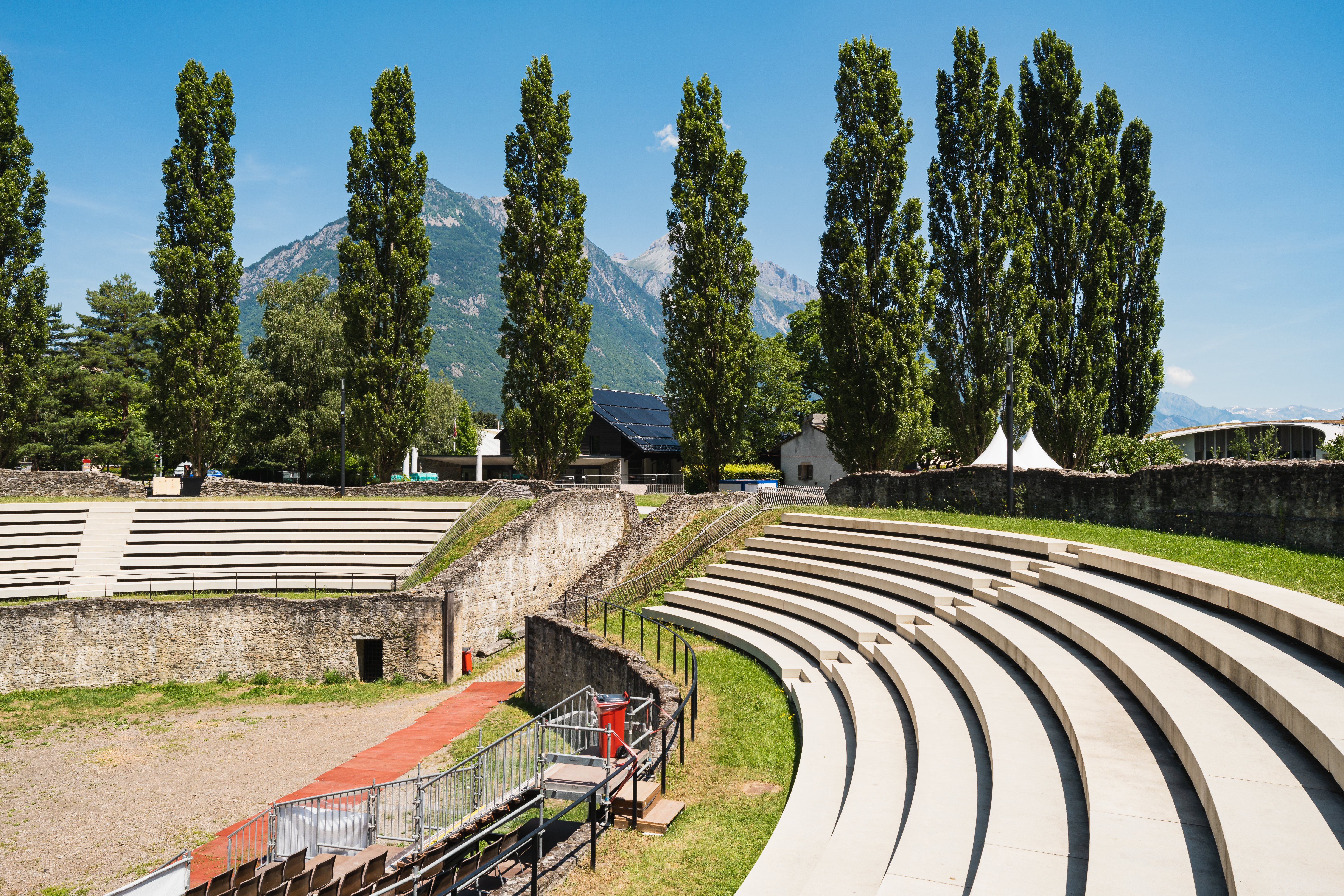
Martigny sits at the elbow of the Rhône Valley in the Valais, where the valley bends sharply north toward Lake Geneva. It is a small town that has been a crossroads for two thousand years — the Romans knew it as Octodurus and built an amphitheatre here, which you can still visit at the Forum d'Octodure on the eastern edge of town, surprisingly well-preserved for a site this far from the Mediterranean. The ruined La Bâtiaz Castle on its promontory above town marks the medieval chapter of the same story.
The town's modern claim to fame is the Fondation Pierre Gianadda, a world-class art foundation built over the remains of a Gallo-Roman temple. The permanent collection includes a sculpture park and a vintage car museum, but it is the rotating exhibitions — Monet, Picasso, Cézanne — that draw visitors from across Switzerland. For a town of 20,000 people, it is an improbable cultural heavyweight. Barryland, the museum dedicated to Saint Bernard rescue dogs, offers a lighter diversion nearby.
Martigny is also the gateway to the Grand St Bernard Pass, the ancient route into Italy that Napoleon famously crossed with his army in 1800. The pass road climbs through vineyards and then forests to the hospice at the top, still run by Augustinian monks and still home to the St Bernard dogs that gave the breed its name. In winter the pass closes, but the tunnel beneath it stays open. The Verbier ski area is a short drive south, making Martigny a practical base for winter sports without Verbier prices.