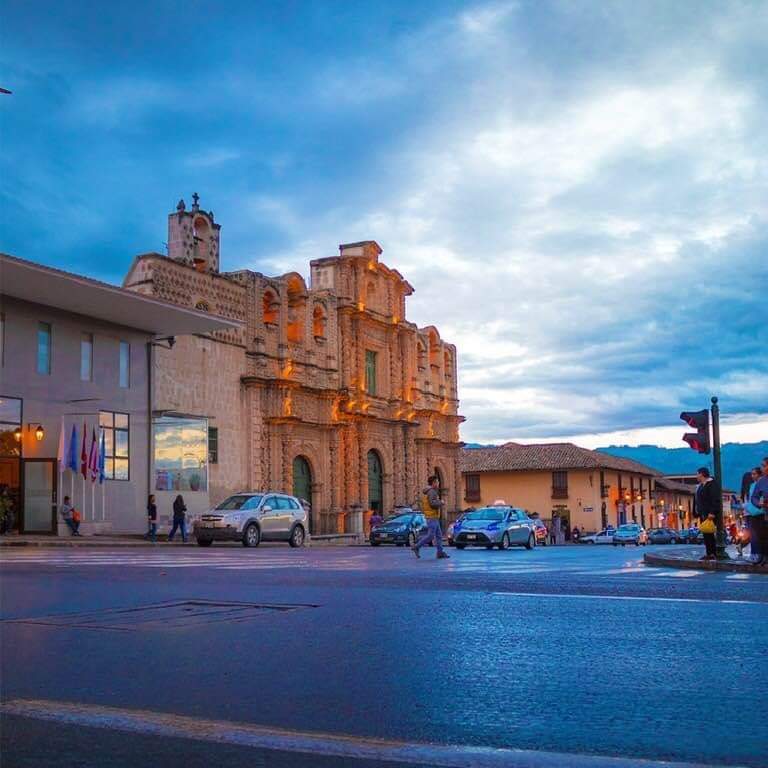
Cajamarca is one of Peru's most historically significant cities and one of the most rewarding to visit. It was here, in November 1532, that Francisco Pizarro ambushed and captured the Inca emperor Atahualpa — a turning point in the Spanish conquest of South America. The Cuarto del Rescate (Ransom Room), where Atahualpa agreed to fill a room with gold and silver in exchange for his freedom, still stands and can be visited.
The city sits in a green valley in the northern highlands at about 2,750 metres, surrounded by dairy farmland and eucalyptus-covered hills. The climate is mild and the air clean. The Plaza de Armas — where Atahualpa was ultimately executed — is one of the finest in Peru, flanked by the Cathedral and the church of San Francisco, both built with the golden volcanic stone that gives Cajamarca its warm colour.
The colonial architecture is excellent throughout the centre: the Bishop's Palace, and the Complejo de Belén with its ornate baroque Iglesia de Belén and two museums are all worth visiting. The Cerro Santa Apolonia, a short climb from the centre, offers panoramic views of the city and valley and has pre-Inca carved stones near the summit.
Outside town, the Baños del Inca — hot springs said to have been used by Atahualpa the morning before his capture — are popular for a soak. The countryside around Cajamarca is dotted with pre-Inca sites, including the necropolis at Ventanillas de Otuzco, with hundreds of burial niches carved into a cliff face.