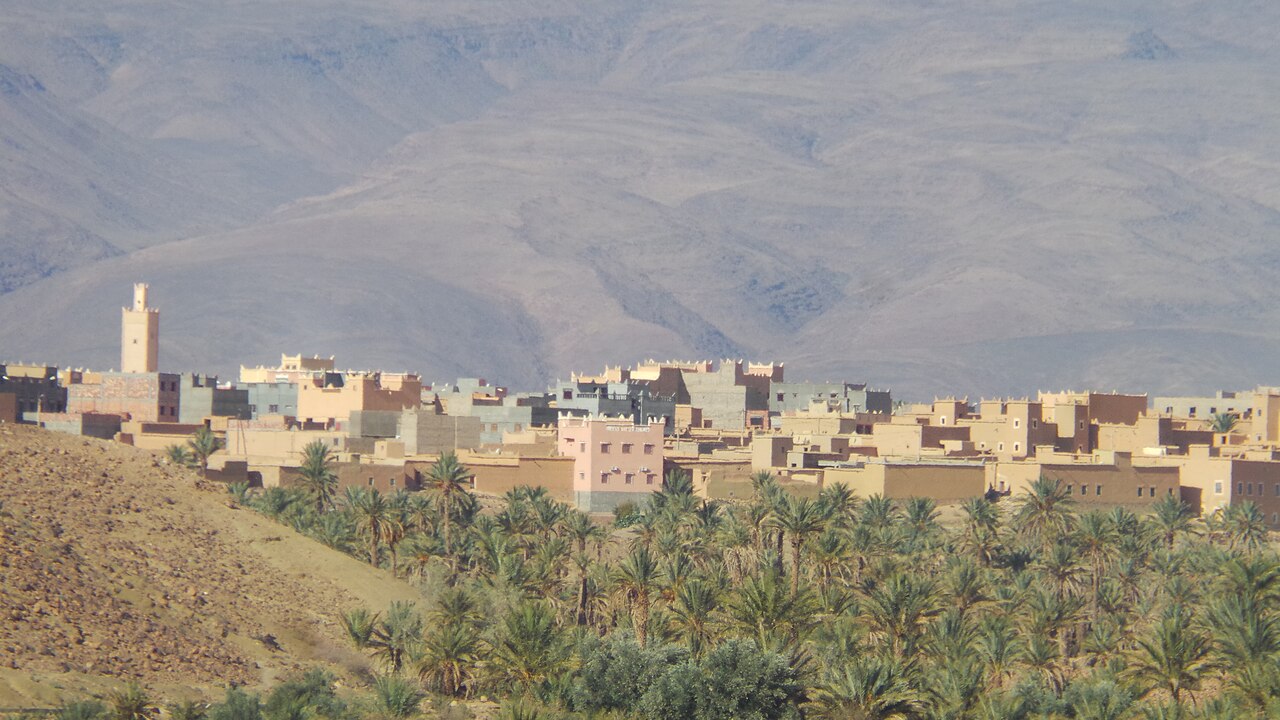
Nkob
©
Nkob

Nkob

Southern Draa Valley village with an exceptional concentration of kasbahs on the road to the Sahara

Nkob is a small village in the southern Draa Valley, about 160 km south of Ouarzazate on the road to Rissani and the Sahara. What makes it remarkable is the extraordinary density of kasbahs — around 45 of them, in varying states of preservation, rising above the palmeries and the semi-arid plateau. The village has been proposed for UNESCO World Heritage listing.

Most travellers pass through on the route between Ouarzazate and the Erg Chebbi dunes, but Nkob rewards a longer stop. The surrounding Jebel Saghro offers some of the wildest trekking in southern Morocco, and the two main palmeries give the village a lush quality that contrasts sharply with the rocky desert landscape outside. The restored Kasbah Baha Baha is the easiest place to step inside one of the village's mud-brick fortified houses.

Guide

Day Trips

Nkob is itself a stop on a longer southern route, but the surrounding region rewards day-tripping. The Jebel Saghro mountains north of the village offer day walks (and multi-day treks with a local guide) through one of the wildest and least-visited mountain ranges in Morocco. The Drâa Valley to the west, with its long ribbon of palm groves and ksour, can be explored back as far as Agdz in a half-day round trip. East along the N12 the villages of Tazzarine and Alnif lead towards the great erg sand dunes of M'Hamid and Erg Chebbi.

Guide

Eating Out

Nkob has only a handful of restaurants, almost all attached to the few small auberges and kasbah hotels in and around the village. Cooking is straightforward Moroccan home food — tagines of lamb with prunes or chicken with preserved lemon, vegetable couscous on Fridays, salads of grilled aubergine and tomato, sweet mint tea. Stop in for lunch at one of the auberges off the main road; dinner is usually included if you are staying at a guesthouse.

Guide

Getting There

Nkob sits on the N12 road that runs east from Agdz (in the Drâa Valley) towards Tazzarine, Alnif and ultimately Rissani — the southern route across pre-Saharan Morocco. The most common approach is from Ouarzazate, around 160 km north-west on the road via Agdz: about three hours by car along a slow but spectacular mountain road.

CTM and other long-distance buses do not generally stop in Nkob, but grands taxis (shared Mercedes saloons) run from Agdz and from Tazzarine. Most travellers drive themselves; the road is paved throughout but narrow, with switchbacks over the Tizi-n-Tinifift pass.

Guide

Things to Do

Nkob is more about looking and walking than about ticking off sights. The 45 surviving kasbahs of the village — most still inhabited, a few crumbling — form the visual landscape, and the best thing to do is climb to the hilltop overlooking the oasis to see them rise as a single skyline. From there, paths drop into the palm groves and into the working life of the village.

The Saghro Mountains begin immediately to the north, and serious trekkers use Nkob as a southern base for multi-day walks. Closer to the village, half-day hikes through the date palmery and out to neighbouring hamlets give a satisfying day in their own right.

Guide

When to Go

Nkob sits on the edge of the pre-Sahara and follows the desert's rhythm. The best months are October to April, when daytime temperatures are 18–25°C and the air is clear. Summer (June to September) can be punishing — afternoons in the high thirties or above forty Celsius, with little shade outside the palmery — and most overland travellers avoid the southern Drâa in those months.

The annual Almond Blossom Festival in February (sometimes called the Fête des Amandiers), held in nearby Tafraout but with smaller versions in Drâa villages, marks the start of spring. The almond and date harvest run roughly through autumn.