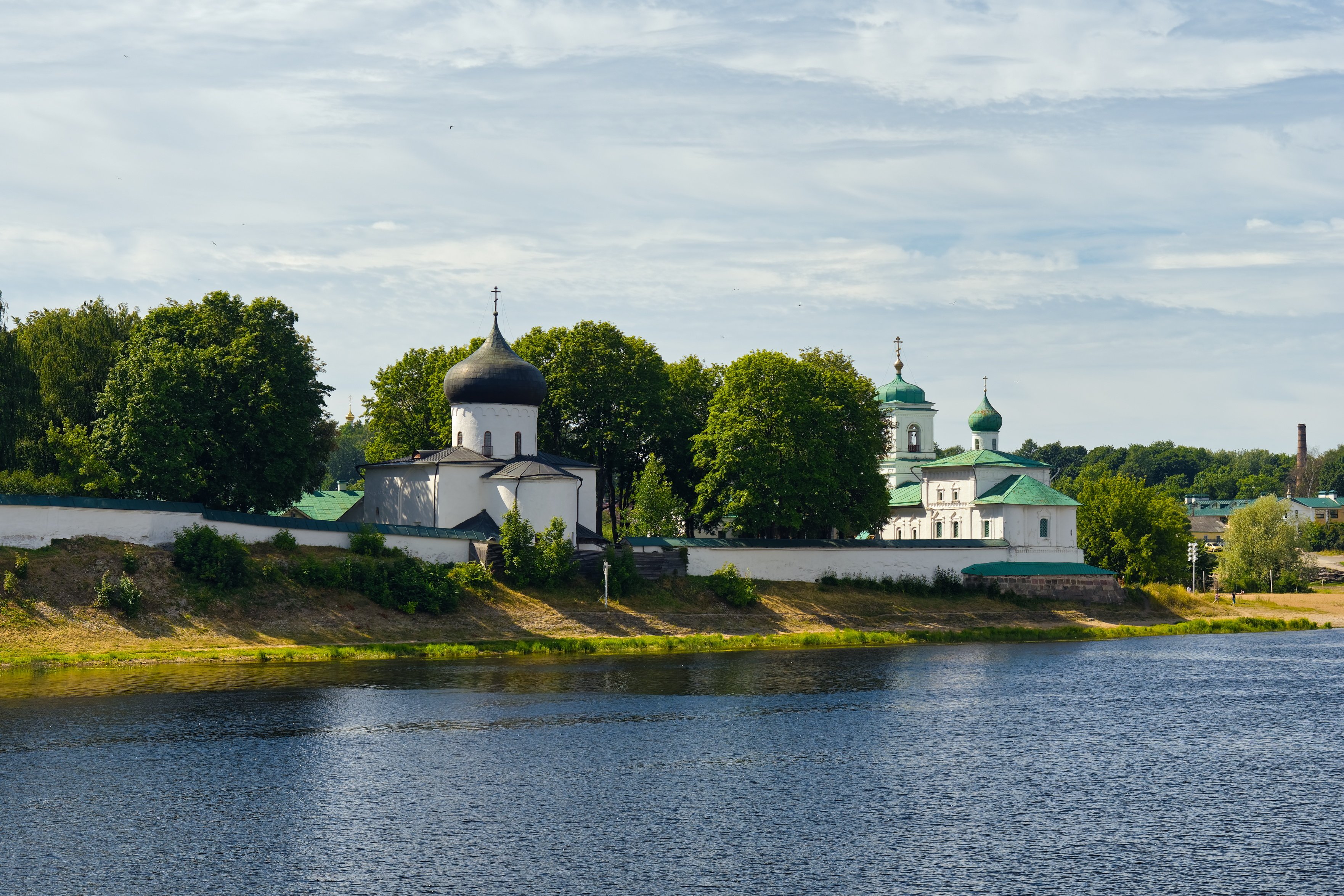
Pskov is one of Russia's oldest cities, founded in the 9th century on the banks of the Velikaya River near what is now the Estonian and Latvian border. Through the medieval period it was the centre of an independent feudal republic — a city of merchants who, given their aggressive neighbours (the Teutonic Order, Lithuania, and Poland), had every reason to build exceptional fortifications. The Pskov Krom, Pskov's medieval kremlin, was besieged 42 times over its history; only twice was it successfully stormed.
The Krom still stands at the heart of the city, sitting on a promontory at the confluence of two rivers. Inside it, the Trinity Cathedral has a remarkable gilded iconostasis nearly 40 metres high. The Pokrovskaya Tower, part of the outer ring of fortifications, was once reputedly the largest single fortification structure in Northern Europe — it's still impressively broad at 40 metres tall.
Beyond the kremlin, the city has more than 40 ancient churches, most built before the 16th century. The Mirozhsky Monastery, across the Velikaya from the kremlin, contains the best-preserved 12th-century Byzantine frescoes in Russia. The nearby fortress town of Izborsk and the Pskov-Pechory Monastery (Pskovo-Pechersky Lavra) — one of the most beautiful active monasteries in Russia, built partly into a hillside — are both worth the short journey out of town.
Pskov is about 300 kilometres from St Petersburg by road or rail, and 50 kilometres from the Estonian border.