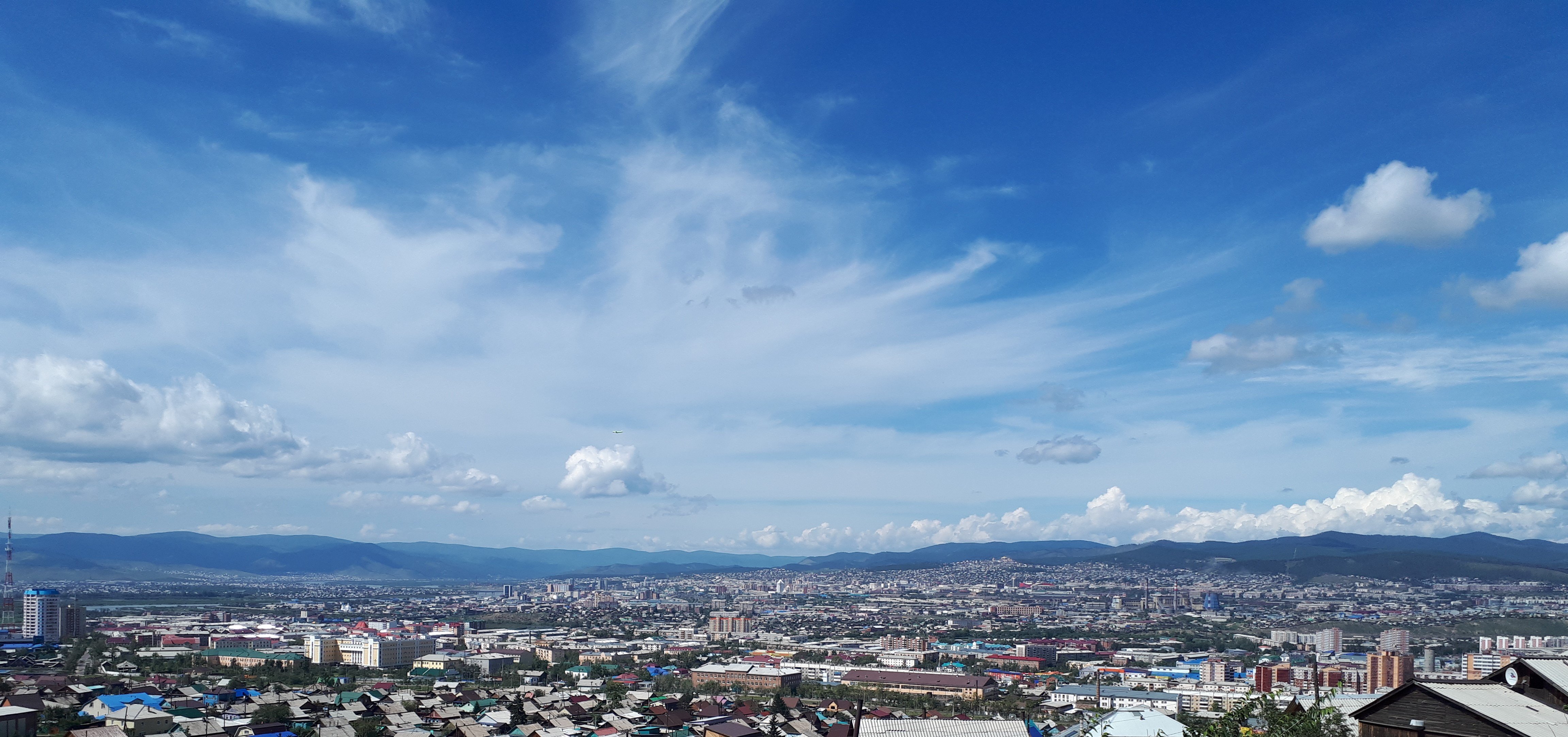
Ulan-Ude is the capital of the Republic of Buryatia, a Russian federal subject whose people share close cultural ties with Mongolia and Tibet. The city sits 100 kilometres southeast of Lake Baikal, in a broad valley where the Selenga and Uda rivers meet, surrounded by the Khamar-Daban and Ulan-Burgasy mountain ranges. It is a natural base for exploring the eastern shores of Baikal, but it also rewards time spent in the city itself.
The most striking feature of Ulan-Ude is the giant bronze head of Lenin in the central square — reportedly the largest Lenin head in the world, and a surreal monument given the Buddhist character of much of the surrounding region. The city's Buryat character is most vivid at the Ivolginsky Datsan, about 25 kilometres outside the city, the spiritual centre of Russian Buddhism. The complex of temples and monasteries draws pilgrims from across Russia and is one of the most atmospheric religious sites in Siberia. The newer Rinpoche Bagsha Datsan on Lysaya Mountain holds the largest indoor Buddha in Russia and looks straight down on the city.
The city was founded in 1666 by Russian Cossacks as a trade post on the route connecting Russia with China and Mongolia. That commercial heritage endures in the old mercantile quarter near the central square, where 18th and 19th-century stone buildings — including the baroque Odigitrievsky Cathedral — survive in reasonable condition. The Trans-Siberian Railway arrived in 1900, and a branch line runs south to Mongolia and China — many travellers stop here on the long journey between Moscow and Beijing. The vast open-air Ethnographic Museum on the edge of town is the best single introduction to the cultures of Transbaikalia.