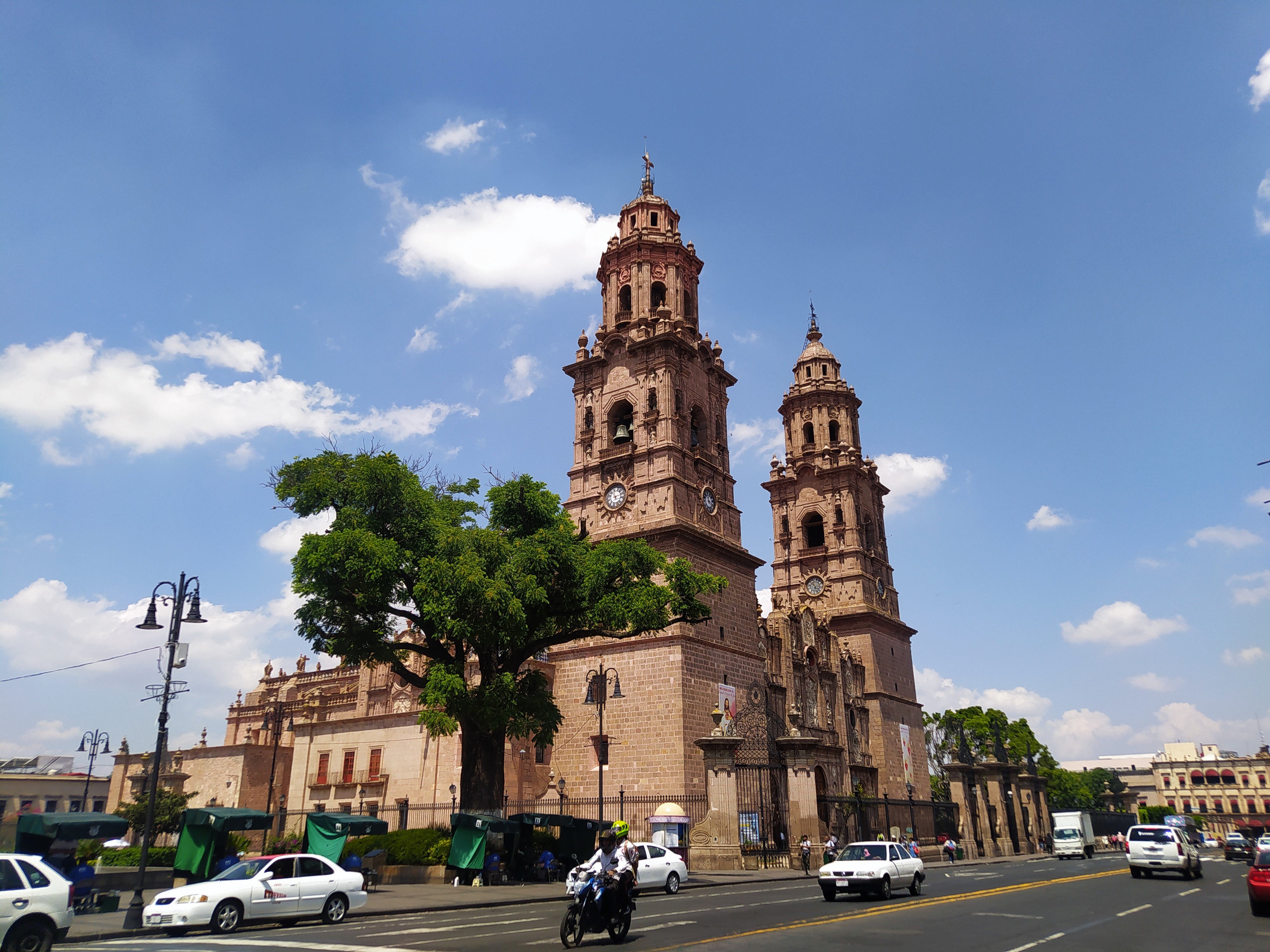
Morelia is the capital of Michoacan state and one of Mexico's most handsome colonial cities. Its historic centre, built almost entirely from pink cantera stone, was declared a UNESCO World Heritage Site in 1991, and walking through it you can see why — block after block of arcaded buildings, baroque churches, and stately plazas, all in that warm rose colour that glows in the late afternoon sun.
The city was founded in 1541 as Valladolid and renamed after independence hero Jose Maria Morelos, who was born here. The Morelia Cathedral, a massive twin-towered baroque structure on the main plaza, dominates the skyline. Inside, the 4,600-pipe German organ is used for evening concerts that fill the nave with sound. Nearby, the Palacio Clavijero — a former Jesuit college — houses exhibitions in one of the finest courtyards in Mexico.
The aqueduct running through the eastern part of the city is Morelia's other icon: 253 arches stretching for nearly two kilometres, lit up at night. The Calzada Fray Antonio de San Miguel, a wide tree-lined walkway, runs alongside it past the Fuente de las Tarascas and is the city's favourite evening stroll.
Morelia is also a gateway to the Monarch Butterfly Biosphere Reserve in the mountains to the east, where millions of monarch butterflies overwinter from November to March — one of the great natural spectacles of the Americas. The reserve is about two hours from the city.
The food scene is strong. Michoacan cuisine is rich and distinctive: uchepos (sweet corn tamales), corundas (triangular tamales), carnitas (the state claims to have invented them), and the elaborate candied sweets for which Morelia is famous throughout Mexico. The Mercado de Dulces, near the Palacio Clavijero, sells nothing but these traditional sweets. For a serious sit-down meal of Michoacan cuisine, LU Cocina Michoacana is one of the finest regional restaurants in the country.