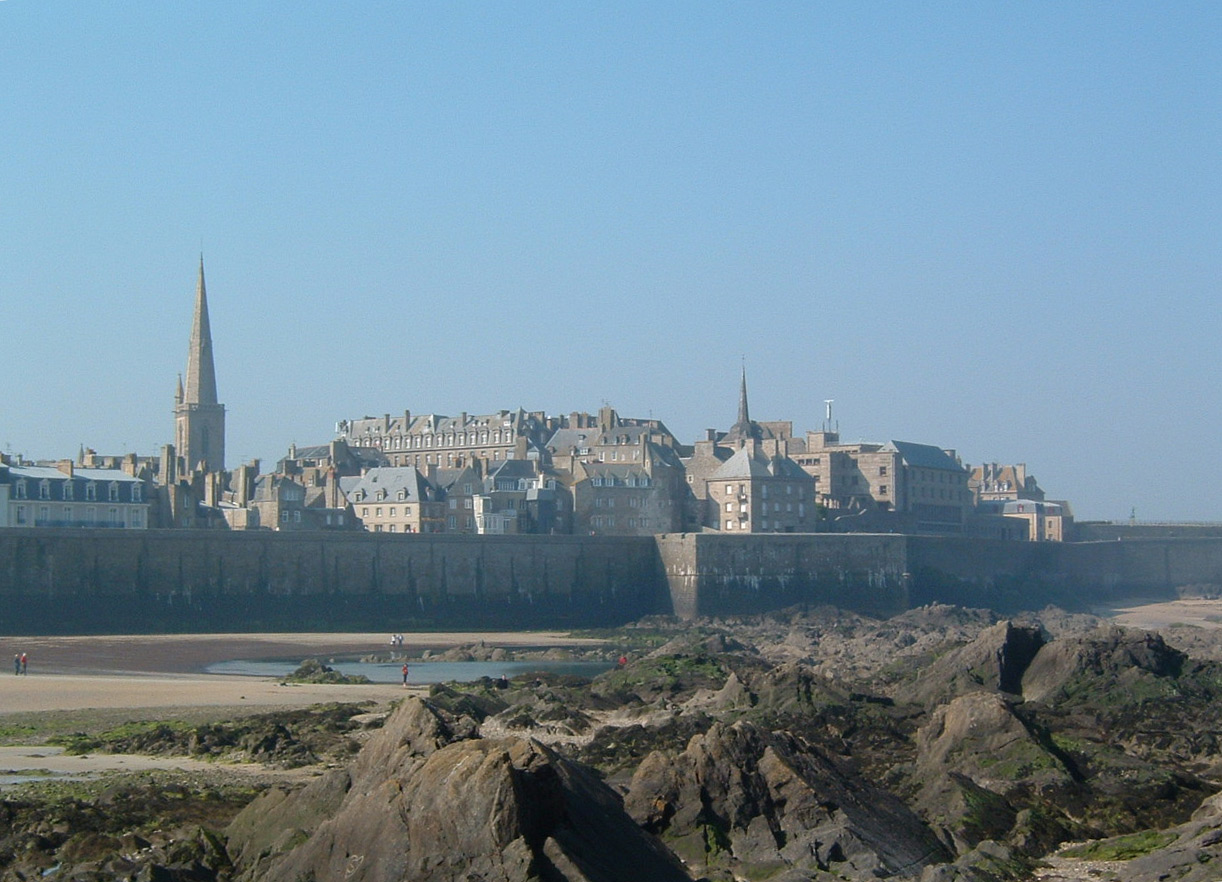
Saint-Malo is a fortified port city on the coast of Brittany, one of the most satisfying medieval walled cities in France. For centuries it was a home port of corsairs — privateers licensed by the French crown to attack enemy shipping — and the money they plundered built the grand granite townhouses that still line the streets of the Intra-Muros. Today most of those buildings are post-1944 reconstructions, but the rebuilding was done so faithfully in local granite that it is difficult to tell.
The ramparts form a complete circuit around the old city and can be walked in about an hour. The views are extraordinary: to seaward, the rocky islands of Grand Bé and Fort National sit in the bay, accessible on foot at low tide when the enormous tides withdraw across the sand. The tidal range here can exceed 12 metres, transforming the landscape every six hours.
The city's maritime history is told at the Château de Saint-Malo, which houses a good museum covering the corsairs, explorer Jacques Cartier (who set sail from Saint-Malo to discover Canada in 1534), and the city's role in Atlantic trade. On the coast nearby, the remarkable rock carvings of Abbé Fouré at Rothéneuf are worth the short trip, and the Rance Tidal Power Station — one of the world's first — is a remarkable piece of 1960s engineering visible from the road to Dinard.
From Saint-Malo you can take a ferry to Jersey and Guernsey. The Channel Islands are visible from the ramparts on clear days, and it is possible to visit them as day trips on the fast catamaran. Dinard, directly across the Rance estuary, is a short ferry ride away.