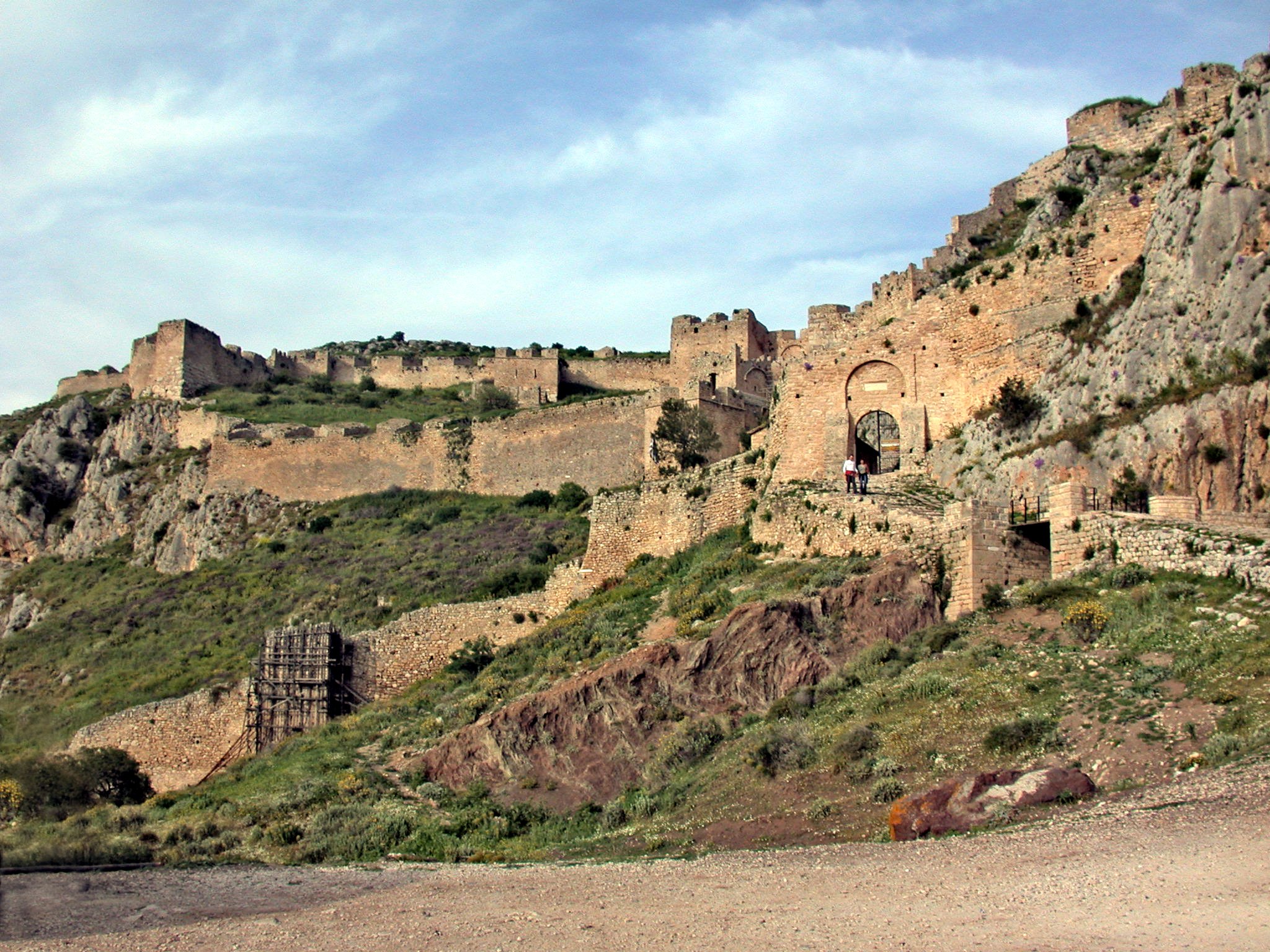
Ancient Corinth was one of the most powerful cities in the Greek world — a wealthy trading hub that sat astride the narrow isthmus connecting mainland Greece to the Peloponnese. Today's city is a modern Greek town rebuilt after a devastating earthquake in 1928, pleasant but unremarkable. What draws visitors is the archaeology: the Ancient Corinth archaeological zone with its seven surviving Doric columns of the Temple of Apollo, the Fountain of Peirene where Bellerophon is said to have caught Pegasus, and above all the great rock fortress of Acrocorinth looming over everything.
Acrocorinth is the highlight. The climb takes about 40 minutes on foot and rewards with sweeping views across the Gulf of Corinth, the isthmus, and on clear days all the way to Athens. The walls you walk through are a palimpsest of history — ancient Greek foundations topped by Byzantine, Frankish, Ottoman, and Venetian additions. The Archaeological Museum in the ancient site houses finds from the excavations including superb Roman mosaics and a collection that puts the site's long history in context.
The Lechaion Road — the marble-paved main street of Roman Corinth — leads from the forum to the bema where St Paul was tried before the proconsul Gallio in 51 AD. The mythologically charged Glauke Fountain, carved from a single block of rock and named for the princess who leapt into it to escape Medea's poison, sits at the western edge of the site and is easy to miss.
Corinth is an easy 90-minute bus ride from Athens and works well as a day trip or as a base for exploring the wider Peloponnese. The Corinth Canal — the narrow, sheer-walled cut that finally severed the isthmus in 1893 — is worth a brief stop on the way in or out, though the view from the bridge is better than lingering.