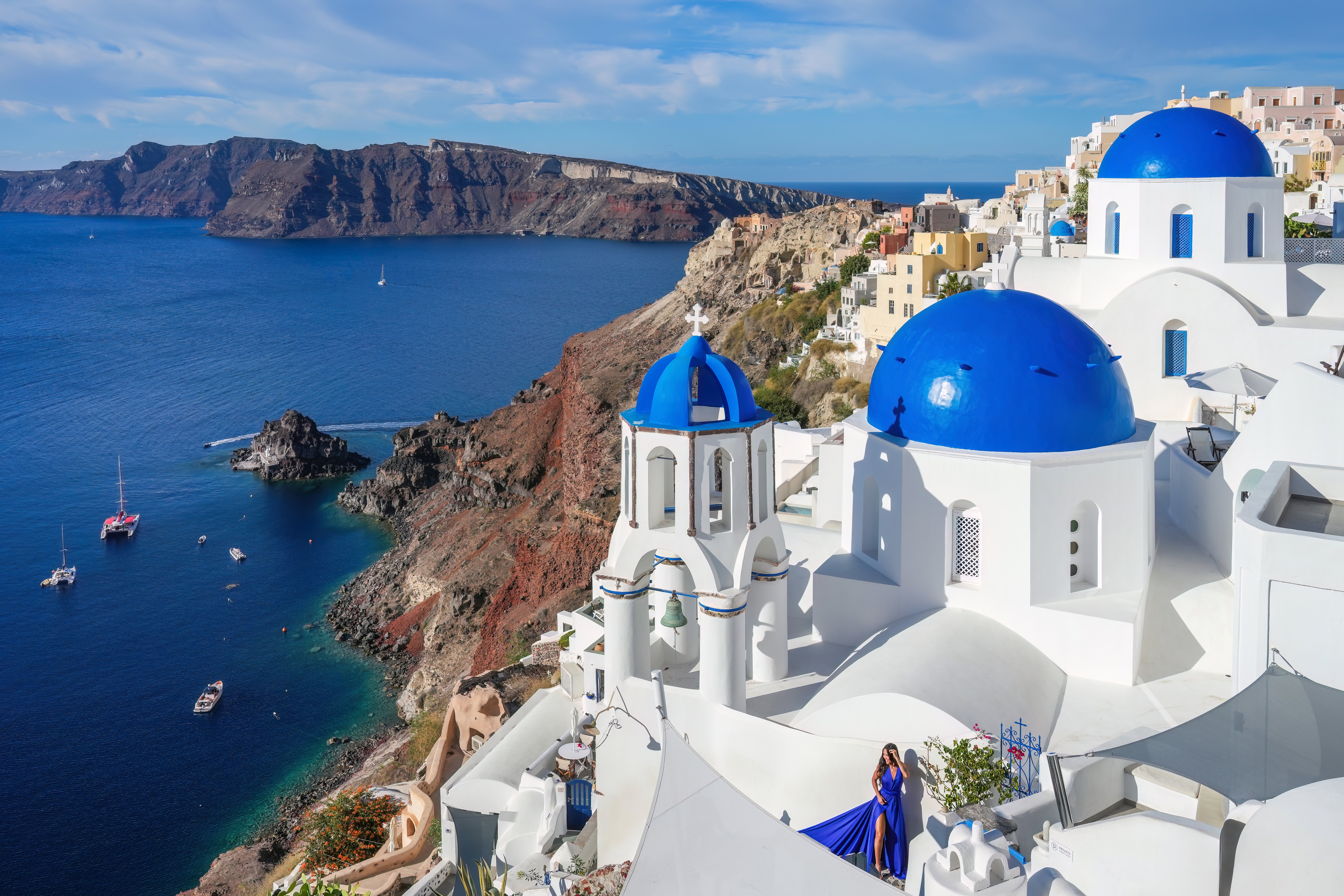
Santorini is unlike anywhere else in Greece. The island is the remnant of a massive volcanic caldera — the eruption around 1600 BC was one of the largest in human history, and it left behind a crescent of steep cliffs, black and red sand beaches, and a flooded crater that forms one of the most dramatic natural harbors in the Mediterranean. The main towns of Fira and Oia cling to the caldera rim, their white-cube houses stacked up the cliff face above a drop of several hundred metres to the sea.
Most visitors come for the scenery, and it delivers. The sunsets from Oia are genuinely spectacular — though you'll share them with a crowd. The ancient site of Akrotiri, a Bronze Age city buried by the eruption, is one of the best-preserved Minoan settlements in the world. The distinctive volcanic beaches — black at Perissa and Perivolos, deep red near Akrotiri — are unlike anything on the mainland.
Santorini is reached by ferry from Athens (Piraeus), Heraklion, and other Cycladic islands, or by direct flights from Athens and seasonal European routes into the small airport near Kamari.