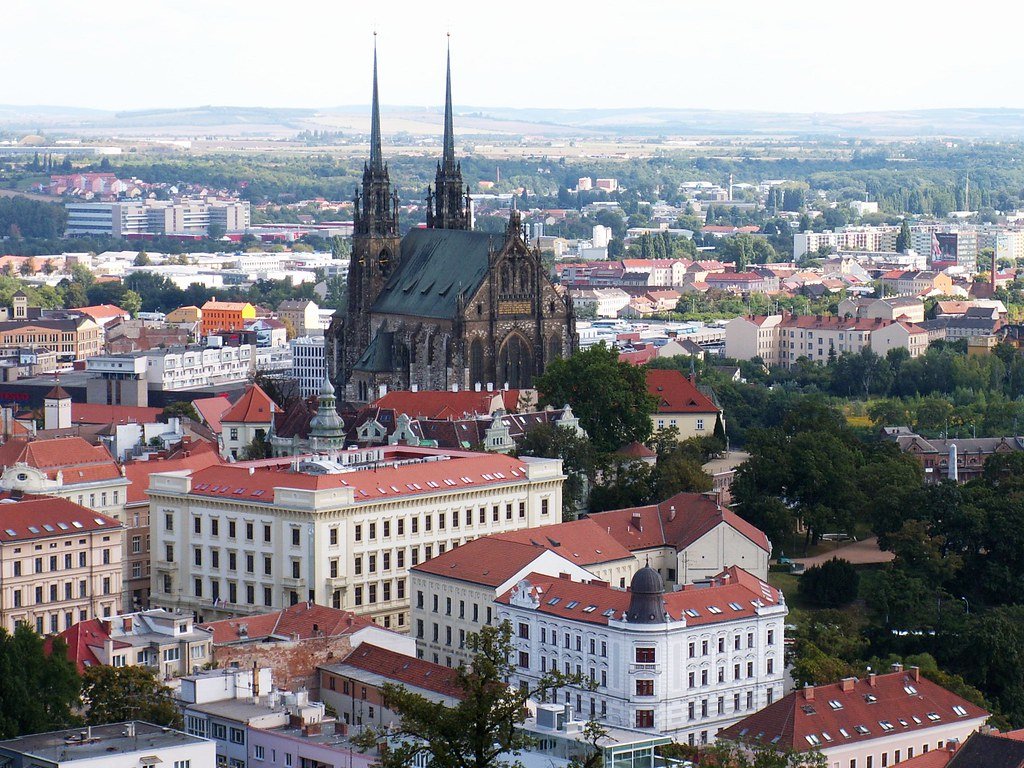
Brno is Moravia's capital and the Czech Republic's second city, with around 380,000 people. It has a reputation among Czechs as the cooler, less tourist-overrun alternative to Prague — that reputation is largely deserved. The city has a strong university culture, a good food and bar scene, and a genuinely lived-in feel that the more polished capital sometimes lacks.
The historic centre sits below Špilberk Castle — a former Habsburg prison whose casemates held political prisoners from across the empire — and the Cathedral of Ss Peter and Paul, whose twin spires dominate the skyline. The Old Town Hall has the city's famous dragon — a stuffed crocodile hanging from the entrance passage with a pleasingly improbable legend attached. Underground, the Capuchin Crypt displays naturally mummified monks, while the Brno Ossuary — discovered by accident in 2001 — contains the bones of some 50,000 people.
Architecturally, Brno is remarkable for its interwar modernism. Villa Tugendhat, designed by Mies van der Rohe in 1930, is one of the most important buildings of the 20th century and a UNESCO World Heritage Site. Tours must be booked in advance. The Moravian Gallery and the Moravian Museum are both worth several hours.
Brno is the capital of the South Moravian wine region, which means good Moravian wine is easy to find in local bars and restaurants. On náměstí Svobody, the main square, the Brno Astronomical Clock fires a marble from one of four slots at 11am — a commemoration of the 1645 siege. The Mahen Theatre was the first building in continental Europe lit by electric light, while the Janáček Theatre — named after the city's most famous composer — is one of the best opera venues in Central Europe for the money. For something darker, the Nuclear Shelter 10-Z is a remarkably preserved Cold War bunker open for tours. The city is also close to the battlefield of Slavkov u Brna (Austerlitz) — Napoleon's great victory in 1805 is commemorated at a memorial about 25 km east of the city.