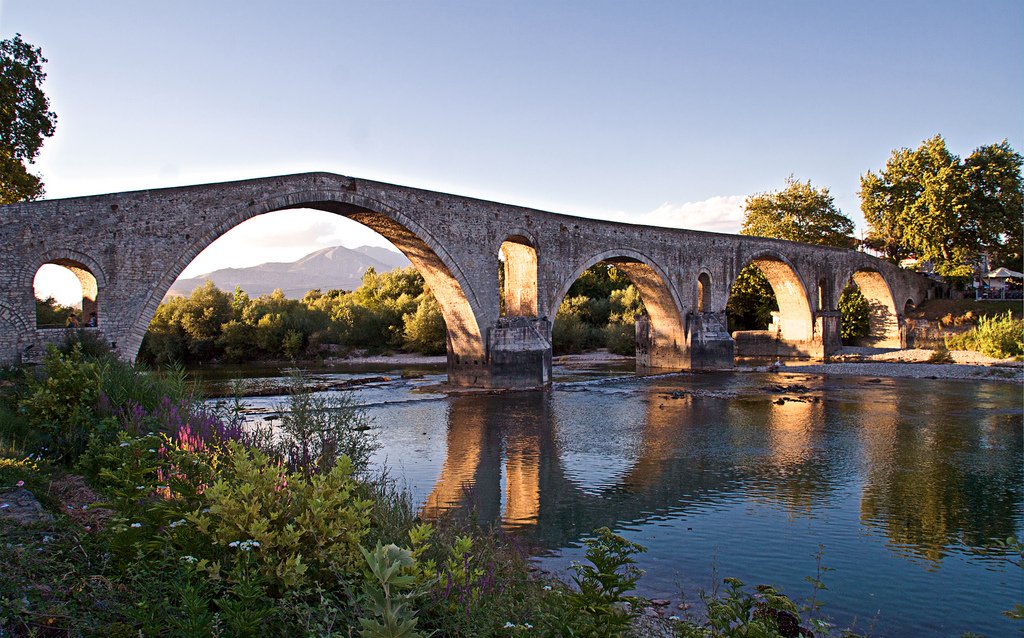
Arta is best known for its bridge — a graceful medieval stone arch over the Arachthos River that has inspired one of Greece's most famous folk songs. The ballad tells of a master builder who could not keep the bridge from collapsing until he sealed his wife into the foundations. The story is dark, the bridge is beautiful, and seeing it in the golden light of late afternoon, perfectly reflected in the still water below, you understand why it became the stuff of legend.
Beyond the bridge, Arta holds one of the richest concentrations of Byzantine architecture in mainland Greece. The town served as the capital of the Despotate of Epirus in the thirteenth century, and several remarkable churches survive from that period. The Panagia Parigoritissa, built in 1290, is the most striking — a cube-like structure whose interior dome is supported by an unusual system of columns and cantilevers that has puzzled architectural historians for centuries. The Church of Agia Theodora and the monastery of Kato Panagia on the river's edge are also worth visiting. Above town, the Castle of Arta gives the best overview of the bend in the Arachthos.
The modern town is a quiet, pleasant place on the edge of the Epirus region, without much tourism infrastructure but with good local food — Arta is known throughout Greece for its oranges, and the citrus groves around the town are lovely in spring. It makes a worthwhile stop between Ioannina and the Ambracian Gulf, particularly for anyone interested in Byzantine art and architecture away from the usual tourist circuits.