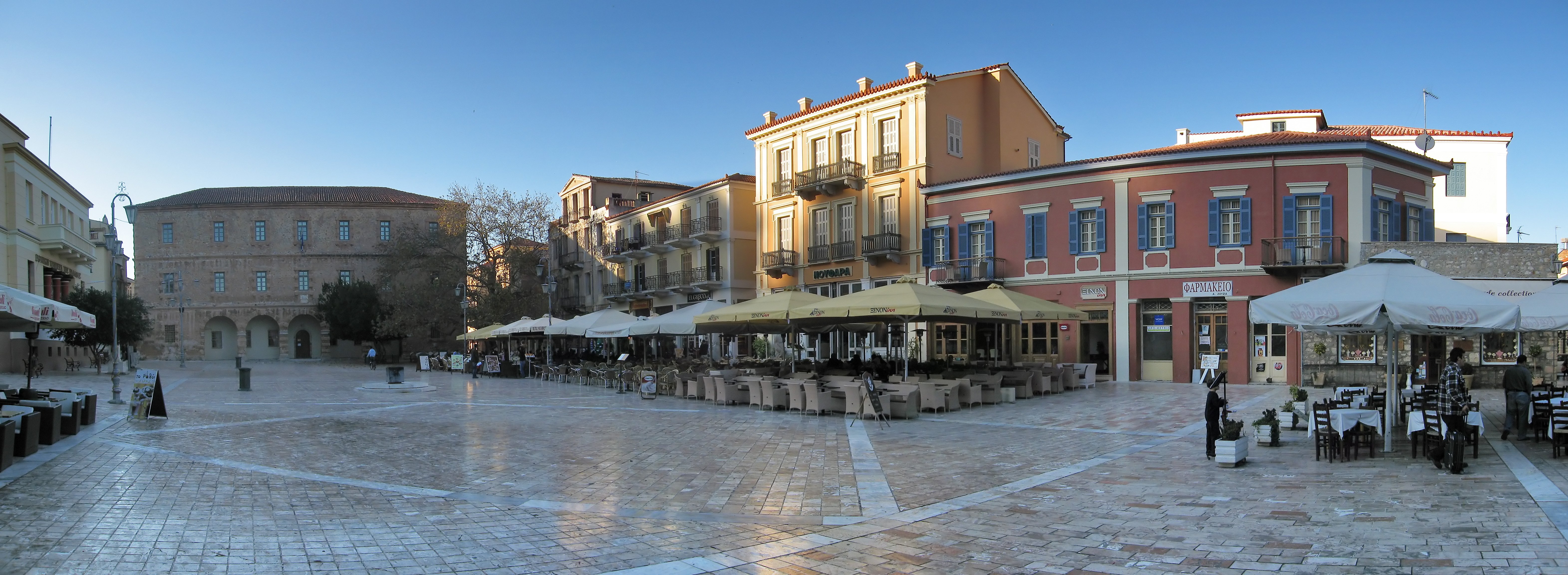
Nafplio is the most attractive town in the Peloponnese and one of the prettiest small towns in Greece. The setting does most of the work: a neat grid of pastel neoclassical houses pressed between the sea and a sheer rock face, the clifftop Palamidi Fortress looking down on it, and the Bourtzi — a Venetian water-castle on its own islet — floating in the bay. Everything significant is walkable; the old town is small enough to cover in an afternoon and rewarding enough to stay several days.
The history is dense for the size. Frankish lords, Venetians, Ottomans and Greeks each held Nafplio in turn between the thirteenth and nineteenth centuries, and each left a layer. The Venetians built the fortresses, the Ottomans built the Vouleftiko and a handful of mosques, and the first Greek government installed itself here after the War of Independence in 1828 — making Nafplio the original capital of modern Greece before it was moved to Athens four years later. It was here, on Syntagma Square, that the first parliament met and the first Greek currency was minted.
The town is also the natural base for the great archaeological sites of the Argolid. Mycenae is a half-hour drive north; Epidaurus, with its astonishing intact theatre, is forty minutes east; and Tiryns, the Mycenaean cyclopean citadel of Heracles, is on the way out of town. The combination of three UNESCO World Heritage sites within an hour, plus a town worth coming for in its own right, makes Nafplio one of the highest-density places in Greece for a short visit.
Days are best spent on foot — climb the 999 steps of Palamidi early before the heat, wander the old town in the afternoon, eat dinner on one of the small squares. The waterfront Arvanitia promenade is the local sunset walk. Hotels in the old town fill up at weekends through summer and the autumn shoulder; book ahead.