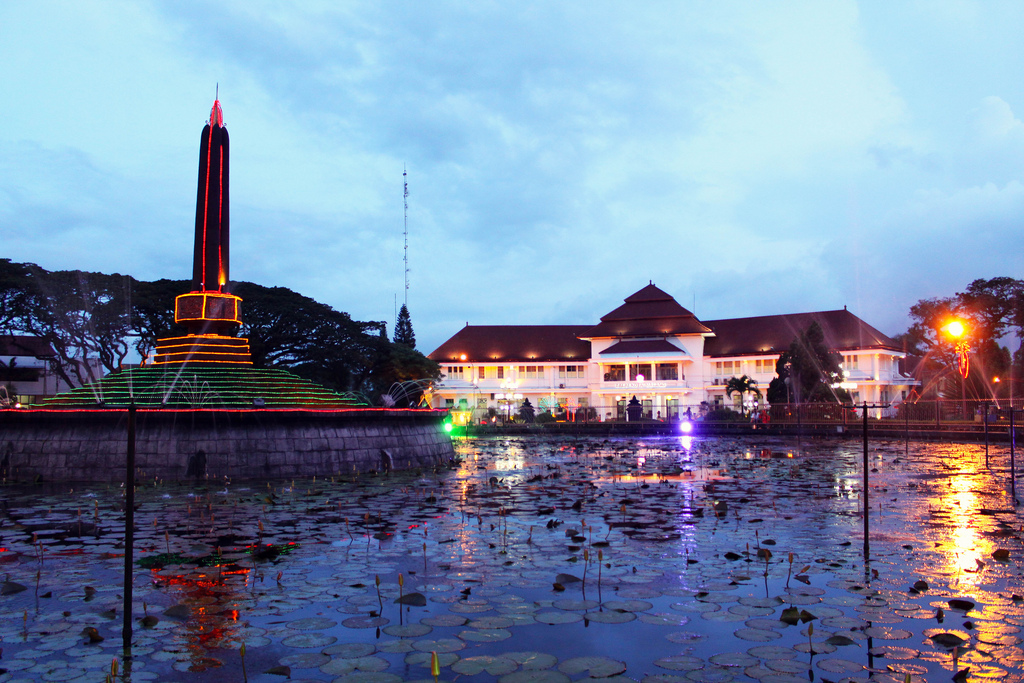
Malang is a highland city in East Java that offers cooler temperatures, cleaner air, and a more relaxed pace than Surabaya, about two hours to the north. Set at around 500 metres, the city has an attractive compact centre with Dutch colonial architecture — wide boulevards lined with art deco buildings, a leafy town square (Alun-Alun), and a sense of faded elegance that rewards a day or two of wandering.
The old town around Jalan Ijen is the most handsome quarter, with grand colonial villas shaded by mature trees. The Tugu Hotel, a beautifully restored heritage property, anchors this neighbourhood. Malang is also known for its street food, particularly bakso (meatball soup) and the local variant of rawon (black beef soup). The Pasar Besar traditional market is lively and worth a visit for spices, batik, and cheap eats. Toko Oen, the colonial-era ice cream parlour and restaurant on Jalan Basuki Rahmat, has been serving the same menu in the same room since 1930.
The Jodipan Colorful Village, a riverside kampung painted in rainbow colours by university students in 2016, has become the city's most photogenic attraction. The Candi Singosari Hindu-Buddhist temple, 10 km north, dates to the 13th-century Singosari kingdom. The Museum Angkut in nearby Batu is one of the largest transport museums in Southeast Asia.
Beyond the city, Malang serves as the southern gateway to some of East Java's most spectacular landscapes. Mount Semeru, Java's highest peak, is accessed via Tumpang to the east. The Bromo-Tengger-Semeru National Park is reachable via the less crowded southern route through Malang, avoiding the tourist-heavy Probolinggo approach. Malang's train station has direct connections to Surabaya, Yogyakarta, and Jakarta.